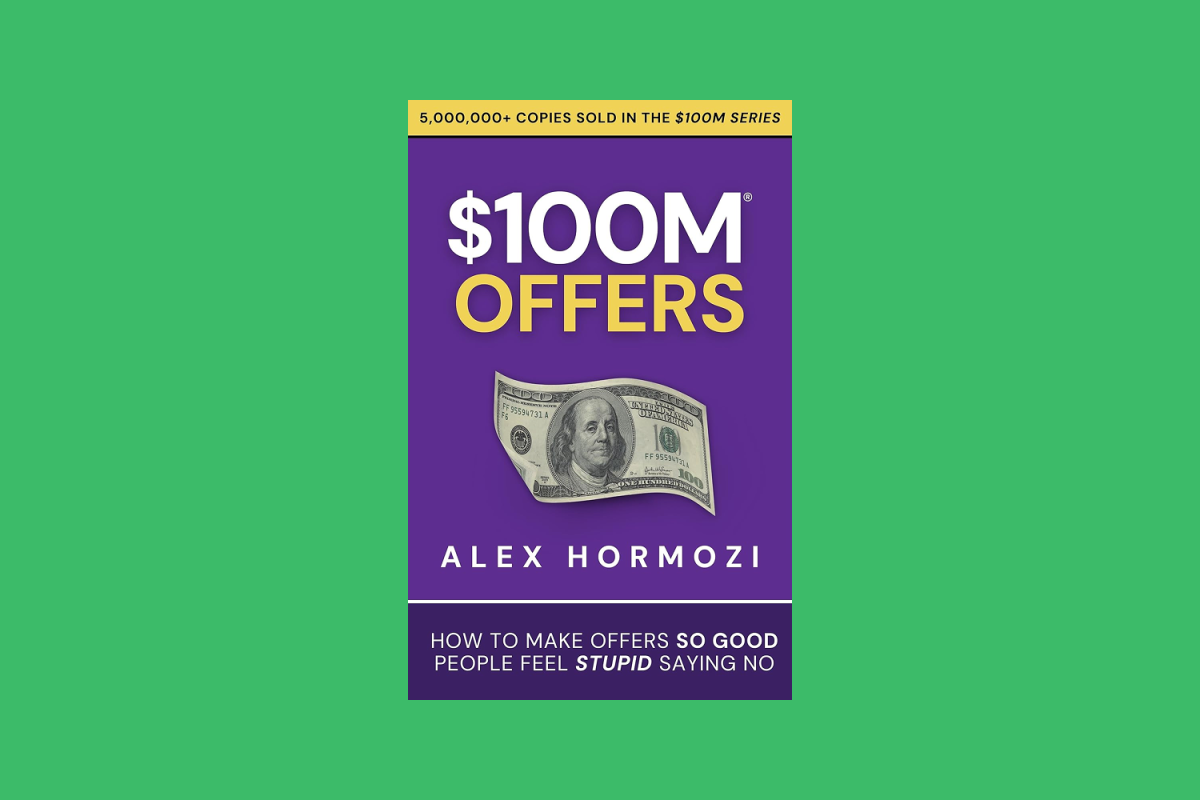
An Imaginary Conversation Between Me and Alex Hormozi
AMEEN: Alex, I have read your book NOW. I have highlighted almost every page. But I need to do something different now. I need to sit with you and go through this thing line by line, idea by idea, until there is nothing left but pure understanding. No fluff. No confusion. Just the raw truth of what you are teaching. Can we do that?
ALEX: Lets do it. But I have one condition.
AMEEN: Name it.
ALEX: We talk like humans. Not like business school professors. Not like guys trying to sound smart on a podcast. We talk like two people sitting across from each other at a kitchen table. If I say something that sounds like it came from a textbook, you stop me. Deal?
AMEEN: Deal. Now let me start at the very beginning. Before the book even starts. The disclaimer says the numbers are theoretical and for illustration. That feels like you are protecting yourself legally. But I want to know: are these numbers real? Did you actually live this?
ALEX: Every single number that matters is real. The story about the payment processor holding my money? Real. The twenty-three thousand dollars in my account becoming one thousand and thirty-six dollars after I paid my salesman? Real. The fear, the shame, the feeling of being a sinking ship that Leila should abandon? All real.
The disclaimer exists because I cannot promise that if you follow my steps, you will get the same results. Your market is different. Your skills are different. Your timing is different. But the frameworks? The principles? Those are as real as gravity.
AMEEN: That makes sense. But I want to go deeper into that opening story. You were in a movie theater on Christmas Eve. Your heart was racing at a hundred beats per minute. You were twenty-seven years old, supposedly in your prime, and you were terrified. What was actually going through your mind in that moment?
ALEX: I was thinking about the salesman who had a baby and another on the way. I was thinking about the fact that I owed him twenty-two thousand dollars in commission for sales I would never see a penny from. I was thinking that I had sold five of my six gyms, put the money into an account with a partner, and that partner had taken every last dollar. I was thinking that my mother was in critical condition from a near-fatal accident. I was thinking that I had totaled my car in a head-on collision at sixty miles per hour and earned a DUI as a consolation prize.
But more than all of that, I was thinking: I have nothing. No gyms. No equipment. No employees. No money. And the one person I love most in this world is sitting next to me, holding my hand, and I am about to tell her that I am a sinking ship.
AMEEN: And what did she say?
ALEX: She grabbed my chin, pulled my face toward hers, looked into my eyes, and said: "I would sleep with you under a bridge if it came to that."
AMEEN: That is heavy.
ALEX: That moment is the foundation of everything I have built since. Not the money. Not the success. That moment. Because when someone looks at you at your absolute lowest and says they will stay, it does something to your soul. It gives you a reason to fight that has nothing to do with money.
AMEEN: But you still had to figure out how to make money. You had two things left: a grand slam offer and an old business credit card with a hundred-thousand-dollar limit. You were about to spend thirty-three hundred dollars per day on money you did not have. Your hand was shaking when you turned the advertisements on. What was the offer?
ALEX: The offer was simple. I would fly to a gym. I would fill it up in twenty-one days. I would do everything. I would pay for the ads. I would work the leads. I would sell for them. I would even do the first onboarding meeting with their clients. They only had to put down five hundred dollars to reserve their date, and I made it refundable at the end of the launch.
AMEEN: So they had zero financial risk, zero time risk, zero effort.
ALEX: Zero.
AMEEN: And you kept all the upfront cash from selling their services.
ALEX: Yes.
AMEEN: That is a crazy offer. Why would anyone say no to that?
ALEX: Exactly. That is the whole point of this book. If you make an offer so good that people feel stupid saying no, you do not need to be a great salesman. You do not need to be a great marketer. You just need to put the offer in front of the right people.
AMEEN: Let me jump ahead to something that has been bugging me. You have a quote from Jeff Bezos at the beginning about swinging for the fences and how business has a long-tailed distribution of returns. You say that in business, every once in a while, you can score a thousand runs with one swing. But you also say that you have a thirty-six-to-one lifetime return on your advertising dollars. That means for every dollar you spend, you get thirty-six back. That is a thirty-six hundred percent return. How is that even possible?
ALEX: It is possible because I have struck out a lot. I have made thousands of offers over the last decade. Most of them failed. Some did okay. And some struck gold. The thirty-six-to-one is the average across all of them. It is the batting average, not the single at-bat.
AMEEN: But you also say that you only need to hit one grand slam offer to retire forever. So if someone reading this book hits one home run, they are set for life?
ALEX: That is exactly what I am saying. I have done it four or five times in my life. And each time, it changed everything.
AMEEN: I want to talk about the two main problems you say every entrepreneur faces. You say they are: not enough clients, and not enough cash. But those two problems seem to be in conflict. To get more clients, you need to spend money. To have more cash, you need to spend less. How do you solve both at the same time?
ALEX: You solve both by making a grand slam offer. Because a grand slam offer does three things at once. First, it gets more people to respond to your advertisements. Second, it gets more of those responders to buy. Third, it gets them to buy at higher prices. So you are getting more customers, paying more per customer, and doing it for the same advertising spend. That is how you solve both problems simultaneously.
AMEEN: Let me play devil's advocate. What if someone is in a boring industry? What if they sell something that is genuinely a commodity? Something that people can compare easily? How do they make a grand slam offer?
ALEX: Every business can be de-commoditized. Every single one. I have worked with chiropractors, dentists, gyms, agencies, plumbers, roofers, dog walkers, physical product companies, software companies, brick-and-mortar stores. Every single one of them was able to create a grand slam offer.
The key is understanding the value equation. Once you understand what actually drives value in the mind of your customer, you can combine those drivers in ways that no one else is doing. You become a category of one.
AMEEN: Let us talk about that value equation. You say there are four drivers. Two on top that you want to increase, and two on the bottom that you want to decrease. The top is dream outcome and perceived likelihood of achievement. The bottom is time delay and effort and sacrifice. And you say the whole thing is a division equation, not an addition equation, because if you can make the bottom equal zero, you get infinity.
ALEX: That is exactly right.
AMEEN: But no one can actually make the bottom equal zero. There is always going to be some time delay. There is always going to be some effort. So is this just a theoretical ideal?
ALEX: It is a hypothetical limit. But the closer you get to it, the more valuable your offer becomes. Think about it this way. If you could click a button and instantly have a six-pack, how much would you pay for that? Infinite amounts. If you could sign a document and instantly have your phone ringing with new qualified prospects, how much would you pay? Infinite amounts.
We are never going to get to infinity. But every step we take toward it increases the value of what we are offering.
AMEEN: You tell a story about the London tunnel system. The biggest increase in rider satisfaction was not from making trains faster. It was from adding a dotted map that showed when the next train was coming. That is a psychological solution, not a logical one.
ALEX: Yes. The logical solution would be to make the trains faster. But that costs billions of dollars. The psychological solution cost a few million dollars and had a bigger impact on how people felt about the experience.
AMEEN: You say that as a business owner, you should increasingly look for psychological solutions rather than logical ones. Why?
ALEX: Because if there were a logical solution, someone probably would have already solved it. The logical solutions have been tried. They are the obvious answers. What is left are the psychological solutions. The non-obvious answers. The things that no one else is doing because they are too busy doing what everyone else is doing.
AMEEN: You give an example of this with elevators. The logical solution is to make elevators faster. The psychological solution is to add floor-to-ceiling mirrors so people are distracted staring at themselves and forget how long they were on the elevator.
ALEX: Exactly. And here is the thing. Once you see the world through this lens, you cannot unsee it. You start noticing all the ways that companies are solving psychological problems rather than logical ones. And you start thinking about how you can do the same thing in your business.
AMEEN: Let us talk about pricing. You say that most business owners are not competing on price or value. They are not competing on anything at all. They just look at what everyone else is doing, take the average, go slightly below to remain competitive, and end up with a value proposition of more for less. And then you drop the bomb: those competitors they are copying are dead broke.
ALEX: That is the big secret that most business owners do not want to hear. The people you are copying are not successful. They are barely surviving. So why would you copy them?
AMEEN: You say that pricing where the market is means you are pricing for market efficiency. Over time, in an efficient marketplace, more competitors enter offering a little more for a little less, until eventually no one can provide any more for any less. At that point, the business owners make just enough to keep going.
ALEX: And then the bottom ten to twenty percent get washed out or lose the will to fight. And then fresh business owners enter with no idea and repeat the process.
AMEEN: You say that most business owners think they are competing on price or value, but they are not. They are just copying what everyone else is doing. And you say that those competitors are dead broke.
ALEX: Yes. And I know that sounds harsh. But it is true. I have lived it. I have been the guy who was copying what everyone else was doing. I have been the guy who was barely surviving. And I can tell you from experience that it is not a way to live.
AMEEN: Let us talk about the virtuous cycle of price. You say that when you decrease your price, you decrease your client's emotional investment, decrease their perceived value of your service, decrease their results, attract the worst clients, and destroy your margin. But when you raise your prices, you increase your client's emotional investment, increase their perceived value, increase their results, attract the best clients, and multiply your margin.
ALEX: That is the whole thing. It is a cycle. And once you understand it, you cannot unsee it.
AMEEN: You give an example of a blind taste test where researchers gave consumers three wines and told them they were different prices. The consumers rated the most expensive one as the best, the second most expensive as second best, and the cheapest as cheap. But it was the exact same wine all three times.
ALEX: Yes. That is the power of price. Higher price means higher perceived value. It is not logical. It is psychological. But it is real.
AMEEN: You say that if you offer a service where a customer must do something to achieve the result, they must be invested. The more invested they are, the more likely they are to achieve the positive result. And therefore, if you care about your customers, you should get them as invested as humanly possible. That means pricing your services in a way that it stings a little when they buy.
ALEX: That sting forces and focuses their attention. Those who pay the most, pay the most attention. And if your customers are more adherent and follow through, and if they achieve better results, then you are providing more value than anyone else.
AMEEN: But you also say that you must be so confident in your delivery, because you have done it so many times, that you know this person will succeed. Experience is what gives you the conviction to ask for someone's entire year's salary as payment.
ALEX: Yes. You must believe so deeply in your solution that when you look at yourself in the mirror at night, alone, your conviction remains unshakable.
AMEEN: Let us talk about the brick exercise. You ask the reader to set a timer for one hundred twenty seconds and write down as many different uses of a brick as they can think of. Then you reveal that you can change the size, the material, the shape. A brick could be a tab of gum, or a standard brick, or a two-foot by two-foot by six-foot block. It could be plastic, gold, clay, wood, or metal. It could have holes in it or divots for interlocking.
ALEX: The point is that every offer has building blocks. The pieces that when combined make an offer irresistible. Our goal is to use divergent thinking to think of as many easy ways to combine these elements to provide value.
AMEEN: You say that in school we are taught convergent thinking. Lots of variables, one answer. Math problems. But life pays you for divergent thinking. Multiple variables, known and unknown, dynamic conditions, multiple answers.
ALEX: Yes. And most people never learn this. They go through their entire lives thinking there is only one right answer. But in business, in marketing, in offers, there are many right answers. And some are more right than others.
AMEEN: Let us talk about the five steps to creating a grand slam offer. Step one is identify the dream outcome. You say that no one wants a membership. They want to lose weight. You were not selling the plane flight. You were selling the vacation.
ALEX: Yes. When you are thinking about your dream outcome, it has to be them arriving at their destination and what they would like to experience.
AMEEN: Step two is list the problems. You say to think about what happens immediately before and immediately after someone uses your product or service. What is the next thing they need help with? You say to think about it in insane detail. And you list out problems like buying healthy food is hard, confusing, and I will not like it. Buying healthy food will take too much time. Buying healthy food is expensive. I will not be able to cook healthy food forever. My family's needs will get in my way. If I travel, I will not know what to get.
ALEX: And each of those problems has four negative elements. Each aligns with the four value drivers. The dream outcome is that this will not be financially worth it. The likelihood of achievement is that it will not work for me specifically. The effort and sacrifice is that this will be too hard, confusing, I will not like it, I will suck at it. And the time is that this will take too much time to do. I am too busy to do this. It will take too long to work.
AMEEN: So you are saying that for every problem a prospect has, there are actually four problems underneath it.
ALEX: Yes. And if you list out all the problems your prospect has, you will end up with thirty-two to sixty-four problems total. No wonder most people do not achieve their goals.
AMEEN: Step three is turn problems into solutions. You say to reverse each element of the obstacle into solution-oriented language. You give the example of buying healthy food is hard, confusing, I will not like it, I will suck at it. That becomes: how to make buying healthy food easy and enjoyable, so that anyone can do it.
ALEX: Yes. That is copywriting 101. It is beyond the scope of the book to get into that, but simply adding how to and then reversing the problem will give most people new to this process a great place to start.
AMEEN: Step four is create your solutions delivery vehicles. You say to think about all the things you could do to solve each of these problems. This is the most important step in the process. This is what you are going to deliver.
ALEX: Yes. And for the purposes of keeping creativity high, think about anything you could possibly do. Think of all the things that might enhance the value of your offer. So much so that they would be stupid to say no.
AMEEN: You say that even if you come up with something you are not actually willing to do, it is okay. The goal here is to push your limits and jog your brain into thinking of a different version of the solution you would normally default to.
ALEX: Yes. This is where you get to flex your entrepreneurial creativity.
AMEEN: Step five is trim and stack. You say to look at the cost of providing these solutions to you, the business. Remove the ones that are high cost and low value first. Then remove low cost, low value items. What should remain are offer items that are low cost, high value, and high cost, high value.
ALEX: Yes. And if there is one type of delivery vehicle to focus on, it is creating high value, one-to-many solutions. These will be the ones that typically have the biggest discrepancy between cost and value.
AMEEN: You give an example of an online training business where you created an Excel sheet application that after inputting all of someone's goals, automatically generated over one hundred meals perfectly suited to their macronutrient and calorie needs. It took you about one hundred hours to put the whole thing together. But from that point going forward, you sold truly personalized eating plans for very expensive prices, but they only took you about fifteen minutes to make.
ALEX: High value. Low cost. These types of solutions require a high, one-time cost of creation, but infinitely low additional effort after. This is exactly why software becomes so valuable.
AMEEN: Let us talk about the final high value deliverable. You say to put all the bundles together into the ultimate high value deliverable. You give the example of the weight loss offer. Buying food becomes the foolproof bargain grocery system that will save hundreds of dollars per month on your food and take less time than your current shopping routine. Cooking becomes the ready-in-five-minutes busy parent cooking guide. Eating becomes the personalized lick your fingers good meal plan. Exercise becomes the fat burning workouts proven to burn more fat than doing it alone.
ALEX: And then you total up the value. Four thousand three hundred fifty-one dollars. All for only five hundred ninety-nine dollars.
AMEEN: But you also say that most of your facilities now sell this bundle for longer periods of time for twenty-four hundred to fifty-two hundred dollars.
ALEX: Yes. And as we got better at creating and monetizing value, the prices and profit of our facilities skyrocketed.
AMEEN: Let us talk about scarcity. You say it is one of the most powerful and least understood forces to unlock unlimited pricing power. The reason an authority like a doctor, a celebrity like Oprah, or a celebrity authority like Dr. Oz can charge egregious rates is because of implied demand. People assume that there is a lot of demand for their time, and therefore not a big supply of it. As a result, it must be expensive.
ALEX: That is right. And it is hard for most businesses to understand what it is like to have an uneven supply and demand curve until you have experienced it.
AMEEN: You tell a story about a time you had two different people offer you fifty thousand dollars for a day of your time after speaking at an event. They were scaling an education business in a niche similar to yours and could not get past the one million per month mark. As someone who was doing one million per week in the same business type, you were a very specific type of person with the keys to their problem. But you did not accept their offers. Why?
ALEX: Because I was making more than fifty thousand dollars per day in profit from my business and did not want the distraction.
AMEEN: You say that after the event concluded and you were speaking with Leila, you realized how you had somehow become one of those people you had always wondered about. It was a very surreal experience. You finally understood how premium prices were truly made. Simple supply and demand. There is little that substitutes for incredible demand.
ALEX: You can try and fake it, but there is a special type of zero fucks given vibe that is hard to replicate when you truly do not need a person's money, or even want it. That is how these guys can charge so much. Because they do not need it. The person who needs the exchange less always has the upper hand.
AMEEN: You say there are three types of scarcity. Limited supply of seats or slots. Limited supply of bonuses. Never available again.
ALEX: Yes. And you can use all three of them in your business.
AMEEN: You give the example of Chanel, a brand that has maintained insane margins and pricing for over a century. They send only one to two of each piece to each store so every store has a different selection and every item is the last or second to last item in stock. This allows them to price far above market and turn buying impulses into purchases.
ALEX: That is a masterclass in scarcity.
AMEEN: You say that with services, it can be trickier to use scarcity. But you give some simple ways to employ scarcity ethically. Total business cap. Growth rate cap. Cohort cap.
ALEX: Yes. And you can also create scarcity by capping your service level and saying that if they leave, they can never return. This type of scarcity makes people think extra hard about leaving.
AMEEN: Let us talk about urgency. You say that scarcity is a function of quantity. Urgency is a function of time. This is where you only limit when people can sign up, rather than how many. Having a defined deadline or cutoff for a purchase or action to occur creates urgency.
ALEX: Yes. And you can use urgency on a consistent basis ethically. Rolling cohorts. Rolling seasonal urgency. Promotional or pricing urgency. Exploding opportunity.
AMEEN: You say that cohort-based rolling urgency works well. If you start clients every week, you can say: if you sign up today, I can get you in with our next group that kicks off on Monday. Otherwise, you will have to wait until our next kickoff date.
ALEX: And if you wanted to juice it up a little bit, you could say: I actually had a client who signed up a few weeks ago drop out, so I have an opening for our next cohort that kicks off on Monday. If you are pretty sure you are gonna do this sooner or later, might as well get in on it now so you can start reaping the rewards sooner rather than paying the same and waiting.
AMEEN: You say that those two tweaks have pushed so many sales over the edge by just reminding a potential customer that if they sign up, they will be starting on Monday, and if they do not, they will have to wait a week.
ALEX: It is small things like this that nudge people to take the action they know they should take anyways.
AMEEN: You say that the biggest sales on a week-long campaign or launch happen in the last four hours of the last day. Up to fifty to sixty percent. That means the last three percent of the time allotted creates fifty to sixty percent of the sales. You say that is completely illogical, but also unmistakably human.
ALEX: Yes. And that is why you should not be afraid of turning business away. You will make more money from the many people who decided to take action than people who actually missed out. Because in reality, those people were never going to buy. Heck, they did not even buy when they had their feet to the fire, so why would they without?
AMEEN: Let us talk about bonuses. You say that a single offer is less valuable than the same offer broken into its component parts and stacked as bonuses. You say that this is why every infomercial of all time continues on with but wait, there is more.
ALEX: They would not use these techniques unless they were effective. Every second of air time costs money and must be justified with ROI.
AMEEN: You say that you should add bonuses instead of discounting whenever possible on core offers. Whenever trying to close a deal, never discount the main offer. It teaches your customers that your prices are negotiable. Adding bonuses to increase value to close the deal is far superior to cutting prices. It puts you in a position of strength and goodwill rather than weakness.
ALEX: Yes. And you can stack bonuses on top of each other. You can also use other people's products and services as bonuses. You can get other businesses to give you their services and products as a part of your bonuses in exchange for exposure to your clients for free. This is free marketing for them, and high value products for you at no cost.
AMEEN: You give the example of a pain clinic. You might get a massage therapist to give you one to two free massages. A chiropractor to give you two free adjustments. A low inflammation food company to give you discounts for their products. Discounts for braces and orthotics. A local health club down the street to give you a personal training session for free and a free month of membership to their pool. Discounts on pharmaceutical drugs from the local pharmacist.
ALEX: And if your offer was four hundred dollars, then the value of these free bonuses alone is worth more than the four hundred dollars.
AMEEN: You say that you can negotiate a group discount and a commission to yourself. You give the example of your supplement company. Gym owner clients who use your sister supplement company Prestige Labs sponsored athletes get a thirty percent discount on your products. On top of that, the sponsored athlete gets paid forty percent of all sales netted after the applied discount.
ALEX: So it is a win-win for everyone. Their clients get it for thirty percent less than our main site. They get paid for giving away exclusive discounts. And we get customers in exchange for the commission paid.
AMEEN: Let us talk about guarantees. You say that the single greatest objection for any product or service being sold is risk. Risk that it does not do what it is supposed to do for them. Therefore, reversing risk is an immediate way to make any offer more attractive.
ALEX: Yes. And you will want to spend a disproportionate amount of time figuring out how you want to reverse it.
AMEEN: You quote Jason Fladlien, who said that he had seen the conversion on an offer two to four times simply by changing the quality of the guarantee.
ALEX: It is that important.
AMEEN: You say that there are four types of guarantees. Unconditional. Conditional. Anti-guarantee. Implied guarantees.
ALEX: And you must always hit your guarantee hard, even if you do not have one. Say it boldly and give the reason why.
AMEEN: You say that sometimes people will take advantage of a crazy guarantee. But not usually. And you say that you must understand the math. If you close one hundred thirty percent as many people, and your refund percentage doubles from five percent to ten percent, you have still made one point two three times the money, or twenty-three percent more, and that all goes to the bottom line.
ALEX: Do not be emotional. Just do the math. For a guarantee to not be worth it, the increase in sales would have to be one hundred percent offset by people who refunded. So an absolute increase in sales of five percent would need to be offset by an absolute increase in refunds of five percent. But that might be a doubling of refunds, which is unlikely. So for the most part, the stronger the guarantee, the higher the net increase in total purchases, even if the refund rate increases alongside it.
AMEEN: You say that guarantees can be effective sellers, but people who buy because of guarantees can become very bad customers. A person who only buys because of a guarantee is a person who may not be willing to put in the work necessary to see success with your product or service.
ALEX: In a world where you want to reverse risk and get customers the best outcome possible, tying your guarantee to the things they need to do to be successful can help all parties.
AMEEN: Let us talk about naming. You say that like the tree that falls in the forest that no one hears, having a grand slam offer will not make you money if no one finds out about it. The goal must be that upon hearing about your offer, your ideal prospects are interested enough to take action. Naming it properly is an integral part of this process.
ALEX: Yes. And you give the example of a free six-week stress release challenge versus a float tank center session. While they may be the same thing, just named differently, you are much more likely to respond to the first.
AMEEN: You say that over time, offers fatigue. And in local markets, they fatigue even faster. You say that in a local market, it costs relatively little to reach an entire population. On most platforms, you can reach one thousand people for about twenty dollars. So if there are two hundred thousand people in your addressable area, then it would only cost you ten thousand dollars to reach all of them one time.
ALEX: Yes. But reaching an audience one time in no way means an offer is fatigued. Most people do not even notice an offer on the first mention. That is why you need to create new creative, new hooks, new stories, and new copy around the same offers. You can still use offers for a long time. But when we are talking about years of use, not months, offers can eventually fatigue.
AMEEN: You say that over time you can rename the offer to refresh it. This one concept will get you leads forever. You say that you are not changing the actual offer. You are only changing the wrapping paper.
ALEX: Yes. The work you do, services you provide, and products you offer will remain unchanged as the name shifts.
AMEEN: You give the magic headline formula. Magnet. Avatar. Goal. Interval. Container. You say that not all of these components are mandatory. You will typically use three to five of them in naming a program or service. If you can fit them all in, great, but it is likely the name will become too long. The shorter and punchier, the better. So it is a balance between brevity and specificity. The only way to really know what works is to write the names out and test them.
ALEX: Yes. And you can use things like rhymes and alliteration to make your names stick in people's minds.
AMEEN: You say that you might be weird, but naming offers is one of your favorite parts of this process. What you want to highlight is that your actual money model, pricing, and services will remain largely unchanged. Changing the wrapper simply means changing the exterior perception of what your grand slam offer is.
ALEX: Yes.
AMEEN: Let us talk about execution. You say that the first hundred thousand dollars is a bitch. You quote Charlie Munger saying that he does not care what you have to do. If it means walking everywhere and not eating anything that was not purchased with a coupon, find a way to get your hands on a hundred thousand dollars. After that, you can ease off the gas a little bit.
ALEX: Yes. And then you tell the story about the day you hit a hundred thousand dollars in your personal bank account. You were in the kitchen. Leila was making dinner. You said: we did it. She said: what do you mean? You said: we did it. We hit a hundred thousand. And she said: like revenue? And you said: no. Like in our personal bank accounts.
AMEEN: You say that she ran over to you, disregarding the food on the stove, and wrapped her arms around your neck, spatula still in hand. She said: I am so proud of you. She squeezed you. You slumped into her arms. It was like every knot in your body that you had been holding onto melted all at once. You could barely contain yourself.
ALEX: But when I think back to it, the feeling I had was not happiness. It was relief. I had moved from fear to security. I had traded feeling like a failure every day, watching my work and effort yield nothing, to realizing a dream. The constant anxiety and fear of what are we gonna do finally be replaced by something else. I finally had time to let myself feel something.
AMEEN: You say that some people get there fast. Some people get there slowly. But everyone gets there eventually, as long as they do not give up. Keep moving forward. Keep getting up. Keep believing it can happen. And it will.
ALEX: Yes.
AMEEN: You say that entrepreneurship is about acquiring skills, beliefs, and character traits. To advance, you find that you must determine which skills, beliefs, and character traits you lack. Most times, you simply need to improve. And the only way to do that is through learning from experience or high quality sources.
ALEX: Yes. And I have received terrible advice from people who were ahead of me at the time. And though experience is the best teacher, she is not the kindest.
AMEEN: You say that it is your most sincere hope that what you produce provides the guidance you so desperately needed when you were coming up on your entrepreneurial journey. And you say that you wish you could cover it all in a single book. But to do your reader the service you wish you had had, you cannot. The devil is in the details. Excellence exists in the depth of knowledge and nuances. That is what separates the greats from everyone else.
ALEX: Yes.
AMEEN: You end by saying that you hope the book creates a small dent in improving the world because you believe no one is coming to save us. It is up to us, as entrepreneurs, to innovate our way into a better world. And that is something you are willing to devote your life to. And you hope your reader is too.
ALEX: Yes.
AMEEN: You say: I am grateful for your attention. You could have given it to anything, and you chose to invest it with me. I take it in high regard. So, sincerely, thank you. Stay hungry. And then you sign it: Alex.