Summary
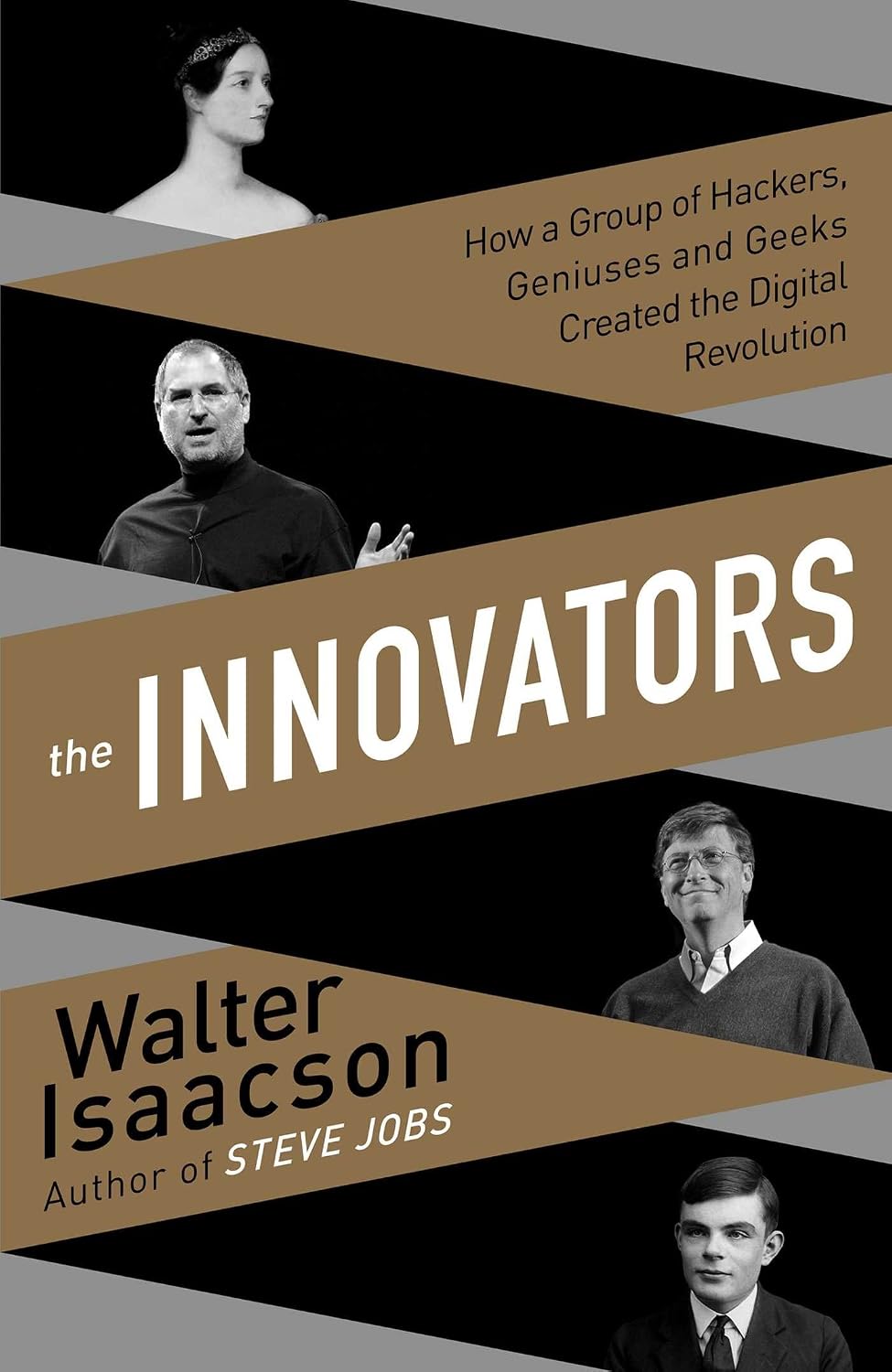
Walter Isaacson does an amazing job of taking us through the progression of digital innovations from the 19th through the 21st century. What is so impressive about this wide ranging group of people is that they were able to turn these disruptive ideas into realities, but not without teaming up with the right partners. These innovations formed the basis of the computer, Internet and entire digital revolution
Key Takeaways
Innovations rarely if ever come from one person but rather draws on multitudes of existing ideas and weaves them into new patterns
The goal now is not to replicate human thinking in machines but to work in symbiosis to reach better results using both our strengths
Innovations are always collaborative and often more evolutionary than revolutionary
Collaboration between thousands or millions of people who might not know each other at all is the closest thing to a revolutionary idea that has come out of the digital revolution
The combination of liberal arts and technology is where our future lies and why [Apple](http://en.wikipedia.org/wiki/Apple_Inc.) has been so successful
What I got out of it
I found this book engaging and easy to follow even though it gets somewhat technical at certain points. It is beautiful to see how men stand of the shoulders of giants before them and build off of their brilliant ideas. As Isaacson says repeatedly throughout the book, innovation never happens alone, is a combination of old ideas and most often are evolutionary rather than revolutionary
Ada Byron was the only daughter of Lord Byron and became enchanted with the beauty of both poetry and science
Known for answering the question - can machines truly think? (No)
Worked with Charles Babbage on his analytical engine and was credited with much of the work - one of the first general computation machines
Was quite arrogant about her intellect and he drastic mood swings which were exacerbated by opiates she was taking as medicine
Her and Babbage had a falling out and they both died in poverty. She of uterine dancer at age 36
One of the first to truly understand and appreciate the future of cooperation between man and machine
Many of her ideas and visions would take over 100 years to come to fruition
Born in 1912 and was quite shy and enjoyed the solitude of long distance running and biking. Turing was homosexual and his first love died soon after meeting him and found it hard to form serious relationships after that
Grappled with the idea of if the mind is distinct from a deterministic machine - thought yes but not as clear as he originally thought
The Turing Test - ask a series of questions and try to determine based on the answers if it is a person or a computer
Turing began working at Princeton in 1937 to break German codes as well as encrypt the U.S. Messages enough so they couldn't be broken (good timing with The Imitation Game recently coming out in theaters depicting these events)
People found out Turing was gay and gave him the option of either going to jail or get hormone injections. Chose injections but committed suicide a year later by biting into an apple laced with cyanide
His thesis calculated the maximum volume per second of communication transmission over finite media. This later become known as the Magna Carta of the Information Age
Lone scientist in Iowa who built one of the first prototype computers - solving simultaneous linear equations
Built the first multipurpose electronic computer (ENIAC) with J. Presper Eckert. He visited Atanasoff in Iowa since he claimed he could build the machine much more cheaply but since it wasn't purely electronic he wasn't too impressed.
One of the most prevalent programmers and wrote the first computing programming manual. Women were in fact mostly in charge of programming and the software which eventually became just as if not more important than the hardware
Along with Turing, is credited with being one of the pioneers in the computing world and especially the stored memory computer
Was considered a type of bee in the sense that he floated around different groups and people and was able to make connections which helped spur many different inventions and industries
Geniuses are able to pick out the one part of an issue that is truly important
The invention of the transistor allowed computers to become infinitely smaller and cheaper
An intense and ingenious man who helped invent the transistor and after leaving Bell started a semiconductor industry in San Francisco (which is why it is now known as Silicon Valley)
Bell Labs was an unbelievable collection of some of the smartest and most creative people in the world from an array of fields and they helped revolutionize or invent transistors, computer circuitry, lasers but wasn't great at monetizing their inventions
Much like Steve Jobs had a reality distortion field and pushed his team to its limits and told customers their needs when they didn't know it themselves such as the transistor radio
Helped create the first integrated circuit while at Texas Instruments
Robert Noyce, Andrew Grove and Gordon Moore (of Moore's Law) left Shockley at Fairchild to start Intel where they were the first to create micro processors and an all purpose chip
Designed Spacewar which was an open source game and later formed Atari where he came up with Pong. Video games were unusual at this time but soon became huge
The new companies being formed in Silicon Valley had drastically different cultures that were less hierarchical and decentralized
Founded Raytheon and had dozens of parents to his name and was one of the first to imagine the personal computer
The single most important person in helping to create the Internet due to decentralized networks and interfaces that would allow people to interact from anywhere
Bob Taylor and Larry Roberts were two of the internets most important architects
ARPANET - the progenitor of what was to become the global internet
Stewart Brand founded the Whole Earth Catalog and pushed for the first picture of earth from space
Ed Roberts founded MITS in New Mexico and created electronic calculators and a DIY computer that wasn't high tech but satisfied the hobbyists needs
Bill Gates and Paul Allen had the foresight to see that the software and not the hardware industry is where the future and the profits were. He was extremely competitive and understood what it took to succeed on both the programming and business side
Gates negotiated some unprecedented deals which made Microsoft the dominant player in the software field by allowing them to license their software to any hardware provider, not just IBM
Jobs and Gates worked together on a limited basis but then had a big argument after jobs stole the GUI from Xerox and then gates stole it from jobs
Created an open source operating system called Linux in Finland
Steve Case and Jim Kimsey created AOL - an easy to use software to get online and connect with others. Sent out free trial discs and that's how they hooked many people. Connection with others was their big bet (chat rooms and social media)
The Internet was opened up to the masses in September 1993 due to less strict government regulations in which Al Gore had a huge role
Tim Berners-Lee invited the world wild web in order to make computers more intuitive. Set out to make hypertext links connect everything
Having a great idea often is not enough. Must partner with someone who can act on the idea and bring it to fruition. Those who can do both are the true geniuses
Browsers were needed to recall the information from other sources and the first truly successful one was Mosaic in 1993 invented by Marc Andreessen. He was brilliant in that he took the constant feedback and criticism and constantly released updated versions
Created the first blog, included a lot of personal things and made the web more intimate and personal. He imbedded a search feature which didn't exist except for in scientific communities.
Evan Williams and Meg Hourihan created Pyra Labs (basis of Blogger) and made posting to the web easy and instantaneous. Williams was eventually a cofounder of Twitter
Created the first wiki, building off Apple's hypercards. It allowed users to post and edit pages - the so-called "read and edit" philosophy.
Created the first free online encyclopedia but it was clunky and slow but when it combined with Cunningham's wiki to form Wikipedia, a movement was born.
It was an experiment that relied on more people being good and posting truthful information and policing the pages than people who want to tear it down.
It fought to be collaborative and neutral. It is the greatest example of online collaborative effort
Jerry Yang and David Filo founded [Yahoo!](http://en.wikipedia.org/wiki/Yahoo!) at Stanford. They counted on people wanting to explore more than find specific information which was wrong and was where Google took over.
Larry Page and Sergey Brin made an excellent team - Page was shyer but both challenged authority and were (are) world-class at thinking outside the box and making world-changing products and services.
Page woke up in the middle of the night with the idea of downloading all hyperlinks so that they can be traced back and forth. The idea being that the better a webpage is, the more other webpages will link to it. This revelation became the heart of Google. Believed that the user is always right and tried to make things as intuitive as possible
In GEB, Hofstadter claimed that the only way to make intelligent machines was to understand how human imagination worked