
"The only way to do great work is to love what you do."
— Steve Jobs
That's Why This book would be a great work , because , I , love , my , work , {marketing} , more thththan I love myself , I am , my works , & , my wwworks , are me .
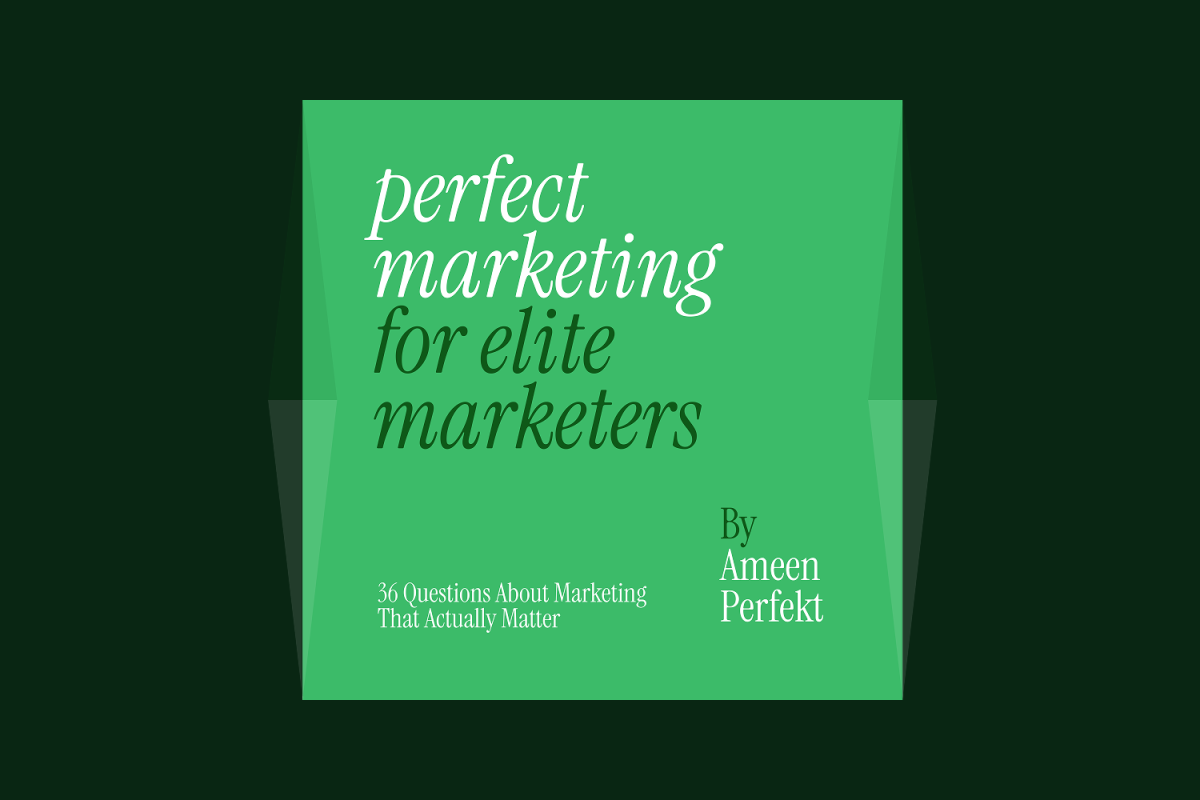
perfect marketing for elite marketers
36 Questions About Marketing That Actually Matter
Ameen Perfekt
Private paid edition , $88
© 2026 Ameen Perfekt . All rights reserved .
This copy is for the person who bought it or the person I personally gave it to . Please, respectfully, don't repost it,, resell it,, copy it into another product , or throw the whole thing onto the internet . I'd rather have 100 people actually use it than 100,000 people save it into a folder called “read later” , haha .
read this before article 01 , seriously
Everyone starts a book with three pages of thanking people , explaining the journey , proving how humble they are,, then warming you up for another five pages before saying anything useful .
We aren't everyone .
We are elites .
& , before somebody gets emotional about the word “elite” , relax . I don't mean a suit , a title , a blue checkmark , a giant agency office , or a person who says “synergy” without laughing .
I mean something much simpler .
An elite marketer is the person who refuses to let one fuzzy thought become one stupid decision , then one stupid campaign , then one stupid $50,000 invoice .
That's it .
The elite person notices what everybody skipped .
he ask the embarrassing question .
he ask the obvious question .
he ask the question that sounds too simple for the meeting room , then , boom , it turns out the entire meeting existed because nobody had answered it .
Who are we actually trying to sell to ?
Why would they care ?
Why would they buy from us ?
Is our prdocut even worth choosing compare to best & worst alternatives?
& Why now ?
Why this price ?
Why this branch ?
Why this message ?
Why this channel ?
What happens if we do nothing ?
What happens if this works ?
What happens if this works beautifully , & still loses money ?
Bingo .
That's marketing .
Not the Canva post . Not,, the boost button . Not the 72-slide strategy deck with a photo of a chessboard on slide 04 . Not the person saying “Gen Z” 18 times because nobody in the room wants to ask what the actual customer problem is .
This book is 36 questions .
That's all .
One thing before we go farther .
I am writing this from the Kurdistan Region of Iraq .
That matters , because every person sees business from somewhere .
But this is not a Kurdistan marketing book .
It is not an Iraq marketing book either .
this is a GLOBAL book
It is a book about the parts of marketing that keep surviving when the country , category , language , platform , budget , & fashion change .
People still choose .
People still compare .
People still copy people they trust .
People still buy status sometimes , safety sometimes , convenience sometimes , belonging sometimes , & plain usefulness sometimes .
Businesses still waste money by solving the wrong problem beautifully .
That part travels .
So , yes , you may see a store , a branch , a distributor , a city , or an imperfect-data market in my examples .
Good .
Those are real businesses .
But take the principle anywhere .
London .
Dubai .
New York .
Erbil .
Tokyo .
A village with one good retailer .
I don't care .
If the principle only works when the data is clean , the customer journey is perfectly tracked , & everybody in the company agrees with marketing , haha , it is not much of a principle .
The geography changes .
The human machine changes less .
& , weirdly , that's the whole point .
I'd rather give you 36 questions that permanently change how you see a business , than give you 360 “marketing tips” that feel smart for 14 minutes , then die somewhere between your screenshots & your bookmarks .
Hmmm , let me say this in the most arrogant , ridiculous , honest way possible .
This is the book that I would pay $1 , 000 , 000 for if somebody could teleport it 3 , 650 days backward , put it on my desk , & somehow force me to actually understand it .
Sounds stupid , maybe .
I mean it .
Not because every sentence inside this book is worth a million dollars .
Nah .
Because one clean way of thinking , learned early enough , compounds into hundreds of decisions .
& hundreds of decisions compound into years .
& years , man , years are expensive .
One bad assumption can make a business advertise the wrong thing for six months .
One lazy definition of “our customer” can make a whole department talk to nobody .
One beautiful campaign can win internal applause , & quietly lose money .
One confused manager can make five talented specialists look average .
One good question , asked at the right moment , can stop all of that before it starts .
That is why this book is small on purpose .
No academic parade .
No dictionary Olympics .
No “holistic omnichannel consumer-centric ecosystem” disease .
If a sentence needs a marketing degree to understand , I probably failed to explain it .
I want the smart 15-year-old to understand it .
I want the senior CMO to read the same sentence , stop for two seconds , & say , yep .
That's the standard .
Simple enough to enter the brain .
Sharp enough to survive the boardroom .
Useful enough to survive Monday morning .
& , one more thing .
This isn't a book for people who want to look like marketers .
It's for people who want to be dangerous to bad marketing .
There is a difference .
Looking like a marketer is easy .
Laptop , coffee , dashboard , black t-shirt , “brand strategy” in the bio , maybe one weird font , done .
Being useful is harder .
You need to understand the business before the campaign .
The market before the media plan .
The customer before the persona template .
The offer before the ad .
The economics before the celebration .
The system before the symptom .
That's what the 36 questions are trying to build inside your head .
Not 36 answers to memorize .
One machine .
You'll start with the business .
Then the market .
Then the customer .
Then the offer .
Then the brand .
Then communication .
Then retail .
Then geography .
Then sales .
Then money .
Then management .
By article 36 , I don't want you to know “more marketing” .
I want you to see more .
That's a much bigger thing .
Because , once you see the whole picture of marketing for a business , a lot of marketing stops looking complicated .
You look at a campaign & see the missing offer .
You look at a weak branch & see that traffic isn't the problem , conversion is .
You look at a competitor & see that their advantage isn't the fancy ad , it's financing .
You look at a report & notice that everybody is celebrating clicks while nobody knows whether the customers were profitable .
You look at a “strategy” & realize it's a calendar wearing a suit .
Haha .
Good .
Now we are getting somewhere .
how to read this thing
First time , read it from 01 to 36 .
Don't jump around because article 29 sounds sexier than article 03 .
The order is doing work .
It moves from the business , outward , then back into the person who has to run the whole machine .
After the first read , destroy the order .
Come back by problem .
Weak campaign ? Go to the message , offer , channel , & measurement questions .
Bad branch ? Go to retail , geography , sales , & reporting .
Budget fight ? Go to CAC , ROAS , management metrics , & budget .
Confused team ? Go to execution , prioritization , centralization , & the weekly manager rhythm .
Use it like a toolbox , not a holy book .
Argue with me .
Write in the margins .
Say “Ameen , nah , this is wrong” , then prove it .
Beautiful .
Thinking beats agreeing .
& , if you paid $88 for this good .
Seriously .
Now make it earn back $880 .
Then $8 , 800 .
Then , maybe , one day , you'll laugh at the $88 .
That is the only kind of book ROI I care about .
Okay .
Enough introduction .
We have a business to make less stupid .
the map , 36 questions , one machine
01 - What Is Marketing Actually Responsible for in a Business? 02 - Where Does a Company's Growth Actually Come From? 03 - What Should Marketing Know About the Business Before Making a Marketing Plan? 04 - What Is a Marketing Strategy , & What Is Just a List of Activities? 05 - How Do You Actually Understand a Market Before Trying to Win It? 06 - How Do You Estimate Market Size When Good Data Barely Exists? 07 - How Do You Do Serious Market Research When the Data Is Incomplete? 08 - How Should a Business Map Its Competitors? 09 - Who Is Actually Our Customer? 10 - Why Do Customers Actually Buy? 11 - What Stops Someone Who Wants a Product From Buying It? 12 - Why Do Customers Choose One Store Over Another When Both Sell the Same Product? 13 - What Are We Really Selling Besides the Product? 14 - Why Isn't “Better Quality” a Positioning Strategy? 15 - How Should a Business Compete When Competitors Sell the Exact Same Brands? 16 - What Is a Brand Actually Supposed to Do for a Business? 17 - How Should an International Brand Be Localized Without Making It Feel Wrong? 18 - What Changes When Marketing Moves From One Market to Another? 19 - How Do You Decide What to Say in an Advertisement? 20 - How Do You Choose Between Meta , Google , Influencers , Outdoor , Events , Email & In-Store Marketing? 21 - Why Can a Beautiful Campaign Still Be Bad Marketing? 22 - How Do You Know Whether a Campaign Is Working Before the Final Sales Number Arrives? 23 - What Is the Job of Marketing Inside a Physical Store? 24 - How Should Online Marketing & Physical Retail Work as One System? 25 - How Do You Market One Brand Across Cities That Behave Differently? 26 - Can One Marketing Strategy Really Work Across Different Markets? 27 - How Do Marketing & Sales Stop Working Like Two Separate Departments? 28 - How Much Can We Afford to Spend to Acquire One Customer? 29 - What Does ROAS Tell You , & What Does It Hide? 30 - Which Marketing Numbers Should Management Actually Care About? 31 - How Should a Marketing Manager Build & Defend a Marketing Budget? 32 - How Do You Turn a Marketing Strategy Into Work People Can Actually Execute? 33 - How Should a Marketing Team Decide What Gets Done First? 34 - What Should Be Centralized , & What Should Local Marketing Teams Control? 35 - What Should Be Inside a Weekly Marketing Report? 36 - What Should a Marketing Manager Actually Do Every Week?
01 , - What Is Marketing , Actually , Responsible , for in a Business ?
Marketing , is often , blamed , for everything , & , trusted , with almost , nothing .
Sales , are down ? Marketing , problem . A new , branch , opened ? Tell , marketing , to promote , it . A competitor , cut , prices ? Make , a campaign . A product , isn't , moving ? Boost , a post .
That's not a serious , way , to , run , a business .
The simplest , useful , definition , is this :
Marketing , is responsible , for creating , shaping , & , capturing , demand .
That sounds , small . Haha , no . It's , not .
Creating , demand , means , making , the right , people , aware , of something , they may want . Shaping , demand , means , helping , them , understand , why this product , brand , store , or , offer , is a better , fit , than , the , alternatives . Capturing , demand , means , making , sure , interest , can actually , become , a sale .
That last , part , is where , many marketing , teams , quietly , fail .
A , beautiful , campaign , can create , interest . But , if the product , is unavailable , the staff , is poorly , trained , the website , is confusing , the branch , is hard , to reach , the , price , makes , no sense , or , nobody , follows , up , with leads , marketing , has created , demand , that the business , can't , capture .
Marketing touches many parts of the company without owning all of them .
It should understand :
- what customers , want ,
- what the company , can profitably , sell ,
- why , people , choose , competitors ,
- how the offer , should be positioned ,
- where demand , comes , from ,
- how much demand , costs ,
- what happens , after , someone , becomes , interested ,
- & , whether , the activity , created , real , business , value .
Marketing , is not , the , same , as advertising . Advertising , is one tool .
Marketing , is not , the same , as branding . Brand , is one asset , marketing , helps , build , & , use .
Marketing , is not , the same , as sales . Sales , converts , many individual , opportunities . Marketing , improves , the conditions , under , which , selling , becomes , easier , cheaper , faster , or , more frequent .
& , marketing , is definitely , not “the department , that makes , posts . ”
A useful , test , is , simple :
If the marketing , team , disappeared , for six , months , what , business , results , would get , worse ?
If the answer , is only “our Instagram , would , become , quiet , ” the marketing , function , is too shallow .
A strong , marketing , function , should affect , things , such , as qualified , demand , store , traffic , customer , acquisition , repeat , buying , product , launches , pricing , communication , category , growth , customer , trust , sales , efficiency , & , market , share .
That doesn't , mean , marketing , controls , all , those numbers , alone .
It means , marketing , understands , how its work , contributes , to , them .
Looking busy isn't the job .
The job , is to make , the market , more likely , to choose , the business , & , to , make , that choice , economically , worthwhile .
02 , - Where Does a Company's , Growth , Actually , Come , From ?
A company , can , say , “We want , 30% , growth . ”
That isn't yet , a , strategy .
Growth , has to come , from somewhere . Bingo . That's the , first , thing , to understand .
At the simplest , level , revenue , grows , when one or , more of these things , happen : 1 . More people , buy . 2 . Existing , customers , buy , more often . 3 . Customers , spend , more each time . 4 . The company , enters , new , markets . 5 . The company , adds , new , products , or , services . 6 . The company , loses , fewer , customers .
That's the , whole , puzzle , before , we start , making , it complicated .
Suppose , a , retailer , makes , $10 , million , a year .
Management , says : “Next , year , we want , $12 , million . ”
Marketing , can't , sensibly , answer , with “we need , more awareness . ”
The better , question , is :
Where , should the extra , $2 , million , come , from ?
Maybe , the company , needs , 20 , 000 , new , customers .
Maybe , it needs , existing , customers , to return , one extra , time .
Maybe , accessories , services , warranties , or , bundles , can increase , the average , basket .
Maybe , a new , city , can contribute , part , of the target .
Maybe , one category , is growing , while , another , is , mature .
Different , sources , of , growth , require , different , marketing .
If the problem , is low , penetration , you need , more buyers .
If the problem , is low , repeat , purchase , more advertising , may , be wasteful . You may need , retention , better , service , better , lifecycle , communication , or , a stronger , reason , to return .
If traffic , is healthy , but , baskets , are small , the issue , may be merchandising , bundles , cross-selling , financing , or , product , mix .
The , mistake , is treating , “growth” , as one thing .
It's not , one thing .
It's a result , created , by several , different , behaviors .
A marketing , manager , should be able , to translate , a growth , target , into , a behavioral , target .
For example :
Business , goal : +20% , revenue Possible , source : +10% , new , buyers , & , +9% , average , order , value Marketing , job : acquire , more , high-intent , customers , & , improve , bundle , attachment Measures : cost , per , acquired , customer , conversion , rate , average , basket , attachment , rate
Now , the goal , becomes , manageable .
There , is another , layer : profitable , growth .
A company , can grow , revenue , while , becoming , weaker .
If it buys , customers , with unsustainable , discounts , spends , more to acquire , them , than , they are worth , or , pushes , low-margin , products , that , destroy , contribution , the graph , goes , up , while , the business , gets , worse .
So the real , question , isn't :
“How do we grow ? ”
It's :
“Which kind , of growth , is available , to us , & , which kind , is worth , paying , for ? ”
That question , is much harder .
It's also , where real , marketing , starts .
03 , - What Should Marketing , Know , About , the Business , Before , Making , a , Marketing , Plan ?
A marketing , plan , shouldn't begin , with content , ideas .
It should begin , with the business . Duh , yes the business .
Before , deciding , what to say , where to advertise , or , how much to spend , a marketing , manager , should understand , the , machine , they are trying , to improve .
At minimum , I , want , answers , to ten , things .
1 . Revenue Where does money come , from ? Which products , branches , channels , & , customer , groups , matter , most ?
2 . Margin A product , that sells , a lot , may contribute , little , profit . Another , may sell , less , but , be , strategically , valuable .
3 . Inventory Marketing , can't , intelligently , create , demand , without , knowing , what's available , overstocked , constrained , or , about , to arrive .
4 . Geography Which cities , branches , or , territories , are strong ? Where is , the business , underpenetrated ? Where is expansion , realistic ?
5 . Customer , mix New , customers , & , existing , customers , aren't the same , problem . Neither , are students , families , professionals , businesses , or , high-value , buyers .
6 . Sales , channels Physical , stores , website , WhatsApp , call , center , B2B , marketplaces , distributors , each channel , changes , how demand , becomes , revenue .
7 . Seasonality Ramadan , back-to-school , product , launches , holidays , salary , cycles , weather , exam , seasons , tourism , or , local , events , can change , buying , patterns , dramatically .
8 . Competitive , pressure Who is taking , customers , on what basis , & , in which categories ?
9 . Business , constraints Budget , staff , systems , supply , approval , processes , brand , rules , lead , times , legal , limits , or , weak , data .
10 . Management , targets What does the company want , this year ? Revenue ? Profit ? market , share ? new , branches ? category , leadership ? customer , retention ?
Without , this context , marketing , becomes , decorative .
Here , is a simple , example .
Imagine , a retailer , asks , for a campaign , to sell , more laptops .
One marketing , team , immediately , develops , visuals .
Another , asks : - Which laptop , models , are , overstocked ? - What's their margin ? - Who buys , them ? - Which branches , are weak ? - Do we have installment , options ? - What , accessories , increase , basket , value ? - Which competitors , are cheaper ? - What's our inventory , cover ? - Is the , problem , traffic , or , conversion ?
The second , team , may produce , a less , glamorous , campaign .
It will probably , produce , a better , business , result .
That's why I keep one simple rule :
Never , write , the marketing , plan , before , you can explain , the business , in plain , language .
If I , can't , explain , how the company , makes , money , where , it's strong , where it leaks , value , & , what management , is trying , to change , I'm , not , ready , to plan , marketing .
I'm , still , collecting , context .
04 - What Is a Marketing Strategy , & What Is Just a List of Activities?
A calendar isn't a strategy .
Neither is : - “We'll post five times a week . ” - “We'll work with influencers . ” - “We'll run outdoor . ” - “We will do Google Ads . ” - “We'll make videos . ”
Those are activities .
Useful , sure .
Strategy ? Nah .
A strategy is a set of choices about what change we want , in which people , where we will focus , what we will make easier to believe , & what we are willing not to do .
That last part matters more than people like admitting .
If nothing is excluded , nothing was really chosen .
“Everyone is our customer . ”
“We'll use every channel . ”
“We'll talk about quality , price , service , innovation , trust , convenience , lifestyle , & community . ”
Cool .
You have not made a strategy .
You have made a shopping list .
Before anything else , ask :
What change are we trying to make , in whom ?
Not “what do we want to post ? ”
Not “what campaign do we need ? ”
What change ?
Maybe we want first-time category buyers to trust us enough to try .
Maybe we want loyal customers to replace sooner .
Maybe we want business buyers to stop seeing us as expensive & start seeing us as lower-risk .
Maybe we want one market to think of us first for one category .
Now we have something to build around .
A useful strategy can usually be explained through seven choices : 1 . Business problem : What are we trying to change ? 2 . Chosen people : Whose behavior matters first ? 3 . Desired change : What do we want those people to do , believe , or feel differently ? 4 . Arena : Which market , category , occasion , geography , or buying situation matters most ? 5 . Value : Why should they choose us ? 6 . Demand system : How will they discover , trust , consider , buy , & return ? 7 . Proof : What result will tell us the strategy is working ?
Then add one ugly little question :
What are we deliberately not doing ?
That question is annoying .
Good .
Strategy should be a little annoying .
Because resources are finite .
Attention is finite .
Management patience is definitely finite , haha .
If every opportunity survives the strategy , the strategy is too weak .
For example :
A retailer might decide that the next stage of growth will come mainly from first-time premium buyers in a small number of priority markets .
The company will win them through trusted authenticity , financing , setup , & after-sales service , not through permanent price leadership .
That means something .
It means the business may say no to constant discounting .
It may say no to campaigns aimed at everybody .
It may say no to media that looks impressive but doesn't reach the chosen buyer .
It may even say no to a profitable-looking activity because it teaches the market the wrong thing about the brand .
Bingo .
Now we have trade-offs .
The opposite is a marketing plan filled with 70 activities & no logic connecting them .
Activity lists feel productive because they are visible .
Strategy is less visible because most of the work is deciding .
A strong strategy should make execution easier .
Designers know what matters .
Media buyers know who matters .
Sales knows the promise being made .
Local teams know what to emphasize .
Management knows what result to expect .
& everybody knows which random “great idea” does not belong .
That is a strategy .
A plan explains who will do the work , when , where , & with what budget .
You need both .
But a perfect plan cannot rescue a strategy that never made a choice .
A business can execute a bad idea with incredible discipline .
That is not excellence .
That is just expensive obedience .
05 - How Do You Actually Understand a Market Before Trying to Win It?
A market , isn't a spreadsheet .
It's people , making , choices , under , real , conditions . Yep , that's the whole , thing .
To , understand , a market , I , want , to see , five , things , at the same , time :
Demand . What do people , want , need , search , for replace , upgrade , postpone , or , avoid ?
Supply . Who is serving , that demand ? What products , prices , channels , & , service , levels , exist ?
Economics . Where is money , being made ? Which categories , grow ? Which are squeezed ? What affects , margin ?
Behavior . How , do people , actually , buy ? Online ? In-store ? Through , recommendation ? After , comparing , prices ? After , asking , friends ?
Structure . What shapes , the , market , from above , distribution , regulation , logistics , currency , technology , purchasing , power , seasonality , or , geography ?
Most weak , research , studies , only one layer .
A competitor , scan , is useful , but , competitors , aren't the market .
A customer , survey , is useful , but , customers , don't , always , know , why they behave , as they do .
Sales , data , is useful , but , your own , sales , only show , the part , of the market , you already , capture .
So I , prefer , triangulation .
Look , at : - internal , sales , - search , behavior , - retailer , visits , - competitor , offers , - customer , interviews , - staff , interviews , - distributor , information , - pricing , - social , conversations , - inventory , movement , - public , data , - local , observation .
Then , look , for contradictions .
If customers , say , price , is everything , but , premium , products , keep , selling , something , else , is happening .
If a competitor , has huge , social , engagement , but , weak , store , traffic , attention , is not converting .
If one city , responds , differently , from another , “the Iraqi , market” , may be too broad , a unit , of , analysis .
Understanding , a market , isn't , collecting , the most data .
It's building , the simplest , model , that explains , the , important , behavior .
A good , market , explanation , might sound , like , this :
Buyers , care , strongly , about , authenticity , because , counterfeits , are common . They compare , prices , aggressively , online , but , many still , prefer , final , purchase , in-store , for expensive , products . Financing , expands , the , reachable , market . Service , quality , matters , most after , the first , purchase , which means , it affects , retention , more than , initial , awareness .
That's useful .
It , tells , you how to compete .
Research , has done , its job , when , it changes , a decision .
If your market , report , is 80 , pages , long , & , the strategy , would , be identical , without , it you did research , theater .
You don't need to know everything .
You need enough of the right things to stop making stupid decisions .
06 , - How , Do You Estimate , Market , Size , When Good , Data , Barely , Exists ?
Sometimes , there , is no clean , report .
No reliable , dashboard .
No beautiful , government , dataset .
That , doesn't , mean , market , sizing , becomes , impossible .
It means , you have , to estimate . Hmmmm , good . Estimation , isn't the enemy .
The word , “estimate” , makes , some people , uncomfortable . It shouldn't .
A transparent , estimate , is better , than , a confident , guess .
There , are two , basic , ways , to size , a market .
Top-down : start , with a large , population , or , spending , pool , & , narrow , it .
Example : Population , → adults , → people , in target , income , range , → likely , category , buyers , → average , annual , spend .
Bottom-up : start , with units , that can be observed .
Example : Number , of , major , retailers , × estimated , monthly , category , sales , + e-commerce , + smaller , sellers , + B2B , demand .
Neither , method , is automatically , correct .
The interesting , part , is when both , methods , land , in roughly , the , same , range .
That is triangulation .
Suppose , you want , to estimate , the premium , smartphone , market , in a city .
You might use : - population , - income , proxies , - smartphone , replacement , cycles , - brand , share , estimates , - import , data , - retailer , count , - store , traffic , - average , selling , price , - financing , adoption , - repair , volumes , - search , demand , - accessory , sales .
No single , number , is sacred .
Each one , reduces , uncertainty .
The most important , habit , is to make , assumptions , visible .
Don't , write :
“The market , is worth , $140 , million . ”
Write :
“Under , a base-case , assumption , of X , annual , buyers , Y , average , selling , price , & , Z , replacement , rate , the market , is , approximately , $140 , million . A reasonable , range , is $110-170 , million . ”
Now , management , can argue , about , assumptions , instead , of arguing , with magic .
This matters , especially , in markets , where informal , trade , fragmented , retail , weak , public , data , & , currency , movement , make , precision , impossible .
False , precision , is worse , than , an honest , range .
A good , market-size , estimate , should help , answer , a business , question : - Is this , category , worth , entering ? - Is this city , large , enough , for another , branch ? - How much share , do we already , have ? - Is a 30% , growth , target , realistic ? - What would 5% , share , be worth ? - How , much sales , capacity , do we need ?
The number isn't there to impress people .
It's there to make a decision less blind .
07 - How Do You Do Serious Market Research When the Data Is Incomplete ?
Incomplete data isn't permission to guess .
It is permission to become better at evidence .
In some markets , the problem is weak public data .
In others , the company has ten dashboards & still doesn't know why customers choose .
Same disease , different outfit .
Serious research means building a picture from several imperfect sources instead of worshipping one perfect-looking source .
I like an evidence stack .
Internal data Sales by product , customer , location , channel , time , margin , returns , repeat purchase .
Field observation Stores , shelves , competitor visits , staff behavior , customer conversations , physical traffic , product availability .
Digital behavior Search interest , website behavior , social conversation , reviews , marketplace activity , CRM behavior .
Commercial sources Suppliers , distributors , service centers , sales teams , logistics partners , resellers , channel partners .
Public sources Government statistics , trade data , industry bodies , company disclosures , research reports , banking , telecom , demographic , or category data .
Direct research Interviews , surveys , mystery shopping , observation , small tests , price experiments , landing pages , calls .
No source is innocent .
Internal sales only show the part of reality your business already captured .
Customers may say one thing & buy another .
Staff can confuse repeated anecdotes with the whole market .
Search data misses plenty of offline demand .
Industry reports can be old before the PDF even reaches your inbox .
Supplier estimates can be useful & biased at the same time .
Fine .
That is why the sources should fight each other a little .
If three unrelated signals point in the same direction , confidence rises .
If they disagree , don't average the disagreement into a pretty number .
Investigate it .
That disagreement might be the most useful thing you found .
I also like ranges more than fake precision .
If the market is uncertain , say :
“Under these assumptions , the market is probably between X & Y . ”
Good .
Now another person can attack the assumptions .
That is healthy .
Writing “the market is exactly 143 , 274 , 991” when half the inputs were guessed is not accuracy .
It is cosplay .
The same principle applies to customer research .
You don't need 10 , 000 respondents before you can learn anything .
Five good interviews won't tell you the size of a behavior .
But they may tell you what behavior to measure next .
A small experiment won't prove a national strategy .
But it may kill one bad assumption before you spend six months defending it .
Research is a loop : observe , guess , test , measure , update . Not : Google , PowerPoint , done .
The final question isn't :
“Do we know everything ? ”
Nah .
Ask :
“Do we know enough of the right things , with enough honesty , to make this decision less stupid ? ”
That standard works in a data-poor market .
It also works in a company drowning in data .
Because the enemy was never missing numbers .
The enemy was false certainty .
08 , - How Should a Business , Map , Its Competitors ?
Most competitor , analysis , starts , with logos .
A logo cemetery isn't analysis .
That's too , shallow . Yep , much too shallow .
A competitor , isn't dangerous , because , its logo , sits , next , to , yours , on a slide .
It's dangerous , because , customers , may choose , it instead , of you .
So I , map , competitors , by the choice , they compete , for .
Start , with direct , competitors .
They , sell , similar , products , to similar , customers , through , similar , channels .
Then , look , at indirect , competitors .
They solve , the same , need , differently .
Then , look , at substitutes .
Sometimes , the , strongest , competitor , isn't another , brand . It's , “do nothing , ” “wait , ” “buy , used , ” “repair , the old , one ” or , “spend , the money , elsewhere . ”
For each serious , competitor , I , want , to , know : - Who do they seem , to target ? - What do they sell , most , aggressively ? - How are they priced ? - What do , they promise ? - Why do customers , trust , them ? - Where do they sell ? - What is their , store , experience , like ? - How strong , is their digital , presence ? - What , promotions , do they repeat ? - What do customers , complain , about ? - What can they do that we can't ? - What can , we do that they can't ?
Then , I , add , one more layer :
What game , are they playing ?
One competitor , may win , on price .
Another , on assortment .
Another , on convenience .
Another , on trust .
Another , on financing .
Another , on status .
Another , on distribution .
Two , businesses , can sell , the , same , products , & , still , play , different , games .
That's why a , simple , SWOT , usually , disappoints , me .
“Competitor , A has strong , social , media” , isn't enough .
What does that strength , allow , them , to do ?
Acquire , customers , more cheaply ?
Launch , products , faster ?
Create , trust ?
Drive , store , traffic ?
A useful , competitor , map , should expose , the structure , of competition .
At the end , I , want , to be able , to answer :
When a , customer , chooses , them , instead , of us , what are they usually , choosing ?
Cheaper ?
Safer ?
Faster ?
Closer ?
More prestigious ?
More available ?
Easier ?
Once , you know , that competitive , strategy , becomes , much more concrete .
The purpose , of competitor , research , isn't , to admire , competitors .
It's , to understand , the reasons , customers , have for , leaving , you .
09 , - Who Is Actually , Our Customer ?
“Men & women , 18-45 . ”
That is not a customer definition .
That is a census range .
Useful for counting people .
Not enough for choosing how to win them .
A useful customer definition changes a decision .
You can segment people by :
Need What are they trying to accomplish ?
Behavior How often do they buy ? Where ? How much ? What do they compare ?
Value Which customers are economically important ?
Category usage New buyer , upgrader , heavy user , occasional user , former buyer .
Buying situation Urgent replacement , gift , business need , first premium purchase , upgrade , emergency , celebration .
Barrier Price-sensitive , trust-sensitive , confused , convenience-driven , risk-avoiding .
Demographics still matter sometimes .
Age , income , city , language , household , occupation , life stage .
But two people who look identical in a spreadsheet can be buying for completely different reasons .
Two 28-year-old men can buy the same phone .
One needs a reliable work device .
One wants the camera .
One wants status .
One wants the ecosystem .
One cracked his old phone yesterday & needs the problem gone by 6 PM .
Their age doesn't tell you which message matters .
The same problem happens with fictional personas .
“Ahmed , 31 , likes football , drinks coffee , uses Instagram . ”
Okay .
What decision did that help us make ?
Now comes the part most segmentation exercises avoid .
You are not only trying to describe the market .
You are trying to choose .
Who matters first ?
Who are we willing to understand unusually well ?
Who can we serve so well that the business becomes obvious to them ?
I call this the smallest audience worth winning .
Not the smallest audience possible .
Not a cute niche for the sake of being narrow .
The smallest group that can support the goal & is coherent enough that you can become meaningfully better for them .
Maybe the market contains 2 million possible buyers .
Fine .
You may still decide that the first battle is 25 , 000 high-value buyers with one clear need .
Why ?
Because “everybody” cannot feel understood .
Everybody cannot receive the same useful offer .
Everybody cannot be reached efficiently with the same proof .
Focus gives the business a chance to become unusually relevant before trying to become universally visible .
That doesn't mean you reject everyone else forever .
It means somebody gets to matter first .
This is the uncomfortable part of customer strategy :
If everybody is equally important , nobody is strategically important .
Good segmentation should lead to different choices : - different offer , - different proof , - different message , - different channel , - different follow-up , - different sales process , - different economics .
Then ask :
What's different about the way this group buys ?
If the answer is nothing , the segment may not deserve to exist .
& then ask one more :
Are we willing to build something meaningfully better for this group , or did we just put a label on them ?
That second question is where customer strategy becomes real .
Good segmentation simplifies reality .
Good selection makes a choice inside that reality .
You need both .
10 , - Why , Do Customers , Actually , Buy ?
People buy because something becomes more valuable to them than the money , effort , risk , & delay required to get it .
That is the basic equation .
Simple , maybe .
Small ? Nah .
Value doesn't mean “features . ”
A feature matters only if it changes something the customer cares about .
A better camera may mean better family memories .
More storage may mean less friction .
A trusted retailer may mean lower fear .
Fast delivery may mean saving an afternoon .
Financing may turn an impossible purchase into a possible one .
But there is another layer marketers often make strangely polite .
People don't only buy utility .
Sometimes they buy identity .
Sometimes status .
Sometimes belonging .
Sometimes they buy a product because it tells themselves :
“I am this kind of person . ”
Or tells other people :
“I am not that kind of person . ”
That is not stupidity .
Humans are social animals .
A watch can tell time & still say something about taste .
A car can move a person from A to B & still say something about success .
A university can teach & still signal identity .
A restaurant can feed you & still tell your friends where you belong .
A phone can be a tool , an ecosystem decision , a trust decision , a status object , or all four at the same time .
Pretending customers are little spreadsheets optimizing features is not sophistication .
It is blindness wearing glasses .
So when I ask why customers buy , I look at six forces :
Desired outcome What do they want to gain ?
Pain What do they want to remove ?
Trigger Why now ?
Confidence Why do they believe this choice will work ?
Identity What does this choice say about who they are , or who they want to become ?
Social meaning What does this choice communicate to other people who matter to them ?
Not every category needs all six .
Toilet paper is not a spiritual identity system , haha .
But the more visible , expensive , risky , emotional , or socially meaningful the purchase is , the more dangerous it becomes to ignore the last two .
The trigger still matters enormously .
A person can want something for six months & still not buy .
Then something happens .
The old device breaks .
A new model launches .
Salary arrives .
A promotion ends .
A friend recommends the store .
A new job begins .
A wedding appears on the calendar .
Demand existed before the trigger .
The trigger turns passive desire into action .
Confidence matters too .
People often don't choose the objectively “best” option .
They choose the option that feels safe enough to choose .
That is why proof , reputation , warranty , reviews , staff behavior , return policy , familiarity , & word of mouth matter .
A good marketing message should help answer : - Why should I care ? - Why now ? - Why this ? - Why from you ? - Why should I believe you ? - What does this choice say about me ? - What could go wrong ?
You don't need to manipulate identity .
You need to notice it when it is already part of the choice .
The customer is not a conversion rate with shoes on .
They are a person making a decision inside a life , a social world , a budget , a fear , & a story about themselves .
Marketing gets much better when we remember all of that at once .
11 , - What , Stops , Someone , Who Wants , a Product , From , Buying , It ?
Interest , isn't , the same , as , a sale .
A customer , can , genuinely , want , the product , & , still , walk , away .
Usually , there , is friction , somewhere . Bingo , find , the friction .
I , group , purchase , friction , into , six , types .
Money , friction . Too expensive , wrong , payment , timing , no financing , weak , perceived , value .
Trust , friction . Fear , of fake , products , weak , warranty , uncertainty , about , the , seller .
Information , friction . The customer , can't , tell , which , model , plan , size , or , option , is right .
Availability , friction . Wrong , color , missing , stock , unavailable , branch , slow , delivery .
Process , friction . Bad , website , slow , staff , too , many steps , poor , checkout , unclear , booking .
Psychological , friction . Fear , of regret , fear , of making , the , wrong , choice , desire , to wait , feeling , that , a better , deal , may appear , tomorrow .
Marketing , teams , often , respond , to , low , conversion , by increasing , traffic .
That , can be like , pouring , more , water , into , a leaking , pipe .
Before , buying , more traffic , inspect , the , leak .
Where do , people , stop ?
What questions , do sales , staff , hear , repeatedly ?
What , causes , abandoned , carts ?
Why , do leads , disappear ?
Which products , receive , interest , but , weak , sell-through ?
What do , customers , ask , on WhatsApp , before , buying ?
Those questions , are evidence .
Try this : write the purchase journey as a sequence : See , → understand , → trust , → compare , → decide , → pay , → receive , → use .
Then , ask , where confidence , drops .
Sometimes , the best , “campaign” , isn't , a , campaign , at all .
It's : - clearer , pricing , - better , product , comparison , - more , visible , warranty , information , - installment , options , - better , stock , visibility , - faster , response , time , - easier , checkout , - stronger , staff , training .
This is , still , marketing , in the , broad , commercial , sense , because , it improves , the company's , ability , to , capture , demand .
The easiest , customer , to , convert , is often , not , a stranger .
It's , someone , who already , wants , what you , sell , but , currently , has one , unanswered , reason , to hesitate .
Find , that , reason .
12 , - Why Do , Customers , Choose , One Store , Over , Another , When , Both , Sell , the Same , Product ?
This is , one of my , favorite , business , questions , because , it exposes , how , much value , exists , around , the product .
Imagine , two , stores .
Same , phone .
Same , storage .
Same , color .
Similar , price .
Yet , one store , sells , far , more . Hmmmm , now , it gets , interesting .
Why ?
Because , customers , aren't , buying , only , the phone .
They are , buying , the whole , transaction .
That includes : - trust , that the product , is , authentic , - confidence , in the , warranty , - product , availability , - staff , knowledge , - convenience , - financing , - trade-in , - setup , - delivery , - store , location , - speed , - after-sales , help , - return , policy , - reputation , - social , proof , - & , how the customer , feels , during , the , purchase .
The , product , can be , identical , while , the risk , feels , completely , different .
That , matters , more as the , price , rises .
For a , cheap , commodity , customers , may tolerate , uncertainty .
For an , expensive , device , car , watch , appliance , or , service , contract , trust , can be worth , money .
Convenience , can also , be worth , money .
A , customer , may knowingly , pay , slightly , more , because , the store , has stock , today , offers , installments , transfers , their , data , is five , minutes , away , or , has , a service , center , they trust .
Competing only on product & price gets dangerous fast for retailers .
If your , product , is available , everywhere , your , differentiation , must , come , from the buying , system , around , it .
I , like , to map , this , as a “value , envelope . ”
Core , product : the thing , itself .
Transaction , value : price , payment , availability , speed .
Risk , reduction : authenticity , warranty , returns , service .
Experience , value : staff , environment , advice , setup .
Relationship , value : CRM , support , loyalty , future , convenience .
Then , ask :
Which , parts , of this , envelope , are customers , willing , to notice , value , or , pay , for ?
That's , where , retail , marketing , becomes , strategic .
You stop , asking , “How , do we , advertise , the phone ? ”
You start , asking :
“Why should buying , this , phone , from us , feel , like , the , obviously , safer , & , easier , choice ? ”
13 , - What , Are We Really , Selling , Besides , the , Product ?
Most businesses , describe , what , they sell , too , narrowly .
A retailer , says , “We , sell , electronics . ”
A bank , says , “We sell , financial , products . ”
A , restaurant , says , “We sell , food . ”
Technically , true .
Commercially , incomplete . Yep , very , incomplete .
Customers , buy , a product , plus , a , set , of outcomes , & , reassurances , around , it .
A premium , electronics , retailer , may be selling : - authenticity , - access , - convenience , - confidence , - financing , - setup , - expertise , - warranty , - after-sales , support , - & , status .
A restaurant , may , be selling , speed , at lunch , a , place , to meet , family , convenience , consistency , or , a , dependable , experience .
This matters , because , the physical , product , is , often , easy , to copy .
The , full , value , system , is harder .
I , like , to , ask , five , questions .
What problem , does , the product , solve ?
What fear , does , the business , remove ?
What inconvenience , does it , eliminate ?
What , confidence , does it , create ?
What , happens , after , the purchase , that competitors , handle , worse ?
The answers , reveal , the , real , offer .
This changes , communication , too .
If you say , only :
“We , have the , new , model , in stock . ”
you're , advertising , inventory .
If the , customer , is worried , about , authenticity , financing , setup , or , warranty , you're , leaving , the most , valuable , part , of the offer , invisible .
Businesses , sometimes , assume , customers , automatically , understand , these benefits .
They don't .
If , something , matters , make , it easy , to , notice .
There , is , also , a strategic , consequence .
If your , business , can't , explain , what it , sells , beyond , the physical , product , it will , eventually , be forced , toward , price , competition .
Because , when two , offers , appear , identical , price , becomes , the , easiest , visible , difference .
The solution , isn't , to invent , emotional , slogans .
It's , to , build , real , value , around , the product , & , explain , that , value , clearly .
First , make , the , offer , better .
Then , make , the better , offer , obvious .
14 - Why Isn't “Better Quality” a Positioning Strategy?
Everyone says quality .
Of course they do , haha .
Quality products .
Quality service .
Quality experience .
High quality .
Premium quality .
Excellent quality .
Cool .
Compared with what , exactly ?
“Quality” is almost useless until you define the dimension .
More durable ?
Safer ?
Faster ?
More accurate ?
More premium ?
More reliable ?
Better designed ?
More authentic ?
Easier to use ?
Better supported after purchase ?
Those can become positions .
“Quality” by itself is an adjective waiting for a strategy .
A strong position should be :
Relevant Customers care .
Distinctive You are meaningfully different , unusually credible , or unusually focused .
Provable The business can show evidence .
Narrow enough to mean something This is the part companies hate .
Positioning is partly the art of saying no .
If you want to be the easiest premium retailer , you may not also be the cheapest store for every deal-hunter .
If you want to be the deepest specialist , you may not serve every category .
If you want to own speed , your operation has to sacrifice things that slow speed down .
If you want to own expertise , you need people , training , content , & service that justify the claim .
A position without sacrifice is usually a wish list .
“We are premium , affordable , fast , personal , innovative , traditional , global , local , specialized , & for everyone . ”
Bingo .
You have positioned yourself as a company .
The uncomfortable positioning question is :
Who are we willing not to be for ?
Not because those people are bad .
Because focus has a cost .
The second question is :
What are we willing to become unusually good at , even if it makes us less attractive to somebody else ?
That is where positioning starts to bite .
For example , “the safest place to buy authentic premium electronics” is much more useful than “quality electronics . ”
Now the business can prove it through authorization , warranty , trained staff , service , traceability , return policy , & consistent experience .
The position also tells the company what to protect .
A discount that damages trust ?
Maybe no .
A branch experience that feels careless ?
Fix it .
A campaign that makes the company look cheap when the position depends on confidence ?
Wrong direction .
Positioning is not a copywriting sentence .
It is a business decision that copywriting later compresses .
A good position should make some decisions easier & some opportunities obviously wrong .
That is useful .
If every opportunity still fits , the position probably isn't doing enough work .
So when somebody says :
“Our position is quality . ”
Ask :
Quality in what exact way , for which people , against which alternative , proven by what , & what are we willing to sacrifice to own it ?
Now we are talking about positioning .
Before that , we were decorating adjectives .
15 , - How , Should , a , Business , Compete , When , Competitors , Sell , the , Exact , Same , Brands ?
This , is , common , in , retail .
Your , competitors , have , the , same , phone .
The , same , laptop .
The , same , watch .
The , same , appliance .
Sometimes , even , the , same , supplier .
So , where , can , advantage , come , from ? Bingo , that , is , the , real , question .
Not , from , the , product , alone .
You , have , to , compete , on , the , system , around , the , product .
There , are , several , places , to , do , that .
Availability . Have , the , right , products , variants , & , accessories , when , people , want , them .
Trust . Reduce , fear , around , authenticity , warranty , returns , & , service .
Convenience . Make , buying , easier , through , location , delivery , online , ordering , pickup , or , fast , response .
Economics . Financing , trade-in , bundles , business , pricing , membership , or , smarter , promotions .
Expertise . Help , customers , choose , correctly .
Experience . Make , the , store , website , setup , & , post-purchase , journey , better .
Relationship . Remember , customers , & , make , the , next , purchase , easier .
Brand . Become , the , retailer , people , think , of , first , for , the , category .
Not every advantage needs to be unique . That's the important bit .
It , can , be , enough , to , be , consistently , better , on , a , combination , customers , value .
For , example : Competitor , A , is , cheapest . Competitor , B , has , the , widest , range . You , may , win , by , being , the , most , trusted , & , easiest , for , premium , purchases .
That's , a , real , strategic , position , if , the , operation , supports , it .
The , mistake , is , competing , on , everything .
“We , have , the , best , price , best , service , biggest , range , fastest , delivery , highest , quality , & , best , experience . ”
Maybe .
Customers , will , not , remember , six , claims .
Pick , the , few , that , matter , most , & , build , them , into , the , business .
Then , make , them , visible .
When , products , are , identical , marketing , becomes , more , not , less , important .
Because , the , customer , is , no , longer , choosing , only , what , to , buy .
They are , choosing , where , from , whom , under , what , conditions , & , with , how , much , confidence .
16 , - What , Is , a , Brand , Actually , Supposed , to , Do , for , a , Business ?
A brand is not a logo .
Yes , everybody says that now .
So let's go one level deeper .
A brand is a set of memories , expectations , associations , stories , & social meanings that make a business easier to recognize , easier to trust , easier to describe , & easier to choose .
A strong brand can reduce several kinds of friction .
Recognition friction People notice you faster .
Trust friction They need less proof each time .
Choice friction You enter the shortlist automatically .
Price friction Customers may accept a premium when they believe the difference is real .
Expansion friction A trusted name can help a new location , category , or product get attention faster .
But brand does something else too .
It gives people language .
Language for themselves .
Language for other people .
“This is the place I trust . ”
“This is the one professionals use . ”
“This is the cheap one . ”
“This is the premium one . ”
“This is the brand people like us buy . ”
“This is the company I send my friends to . ”
That last sentence matters a lot .
A brand becomes much more valuable when customers can carry it for you .
Not because you begged them to “share with a friend . ”
Because the experience gave them something worth retelling .
Maybe the company solved a problem nobody else solved .
Maybe the staff advised the customer not to buy the more expensive option .
Maybe the guarantee was unusually generous .
Maybe the product says something about identity or taste .
Maybe the experience was simply so dependable that recommending it makes the customer look smart .
Word of mouth is not free media .
It is usually the delayed result of a product , promise , experience , or story worth repeating .
That is why brand is economically useful .
It can lower the amount of explanation needed before the next sale .
It can lower perceived risk .
It can increase direct demand .
It can make paid advertising work harder because the name already means something .
But only when the associations connect to reality .
If the company wants to be known for reliability , operations must be reliable .
If it wants to be known for expertise , staff must know things .
If it wants to be premium , a hundred cheap little interactions cannot keep arguing with the position .
Marketing can shape the promise .
The business has to deliver the evidence .
Ask :
What do people expect before we say anything ?
Then ask :
What would a happy customer naturally say about us to another person ?
If the answer is vague , the brand may still be vague .
The strongest brands compress meaning .
A few seconds of recognition can carry years of accumulated evidence .
That is the job .
Not to decorate the company .
To make choosing it easier , remembering it easier , & talking about it easier .
17 , - How , Should , an , International , Brand , Be , Localized , Without , Making , It , Feel , Wrong ?
Localization , isn't , translation . Duh ? Maybe . Yet , people , still , do , it , like , it's .
It's , preserving , the , brand , while , making , the , communication , feel , natural , in , the , market .
The , first , rule , is , simple :
Don't , localize , what , should , remain , global .
Core , identity , product , truth , brand , standards , major , claims , & , distinctive , assets , often , need , strong , consistency .
Then , adapt , the , parts , that , depend , on , context . Language . Examples . Cultural , references . Media , choices . Creators . Retail , moments . Customer , questions . Service , explanations . Payment , & , delivery , realities .
The , danger , is , over-localization .
A , premium , international , brand , can , suddenly , start , sounding , like , a , completely , different , local , business , because , someone , tries , too , hard , to , be , relatable .
The , opposite , is , also , bad .
Literal , translation , can , make , the , brand , feel , robotic , distant , or , accidentally , strange .
Good , localization , asks :
“If , this , brand , had , been , born , speaking , this , language , how , would , it , express , the , same , idea ? ”
Not :
“What's , the , dictionary , equivalent , of , this , sentence ? ”
There , is , also , a , commercial , layer .
A , global , campaign , may , assume , customers , already , understand , financing , warranty , trade-in , delivery , or , product , categories , in , the , same , way .
Local , marketing , may , need , to , explain , those , things , differently .
That , isn't , changing , the , brand .
It's , removing , local , friction .
The , test , is , whether , two , things , remain , true , at , once : A , global , brand , manager , should , still , recognize , the , brand . A , local , customer , shouldn't , feel , that , the , communication , was , written , somewhere , else , & , mechanically , imported .
That , balance , is , the , craft .
18 - What Changes When Marketing Moves From One Market to Another ?
Universal principles exist .
Universal executions usually don't .
That distinction saves a lot of stupid copying .
Customers everywhere care about value .
But what counts as value can change .
People everywhere need some level of trust .
But the source of trust can change .
A recommendation from a friend may dominate in one market .
Reviews may dominate in another .
An official certification may matter enormously somewhere else .
The product can stay identical while the buying system changes around it .
When marketing moves from one market to another , I look for seven things .
Language Not just translation . What sounds natural ? What sounds formal , cheap , funny , elite , distant , or fake ?
Trust Do people trust institutions , brands , retailers , experts , creators , friends , family , or visible local presence ?
Status Which products , brands , places , & behaviors carry social meaning here ?
Channel behavior Where do people actually discover , compare , ask , negotiate , buy , & complain ?
Economics Income , financing , currency , taxes , delivery , margin , payment habits , price sensitivity .
Market structure Modern retail , fragmented sellers , distributors , marketplaces , resellers , informal trade , direct sales .
Data quality What can we truly measure , & what are we pretending to know ?
The mistake is importing a playbook because it worked somewhere impressive .
“We did this in London . ”
Nice .
Does the mechanism travel ?
That is the question .
A principle may travel .
A tactic may not .
Scarcity works across cultures .
The exact way you communicate scarcity may change .
Social proof matters broadly .
Who counts as credible social proof can change completely .
Convenience matters .
What people call convenient changes with geography , infrastructure , delivery , payment , & habits .
This is why local adaptation is not “translate the caption” or “change the model in the photo . ”
That is surface work .
Real adaptation asks :
Which part of the buying mechanism changed here ?
Maybe the product doesn't need localization .
The proof does .
Maybe the message doesn't need localization .
The channel does .
Maybe the brand doesn't need localization .
The payment system does .
Maybe nothing needs localization except one stupid checkout step nobody at headquarters noticed .
Good .
Fix the thing that changed .
Don't romanticize local markets either .
Every country loves believing its customers are completely unique .
Usually they aren't .
Humans are still humans .
The useful skill is knowing which differences are commercially meaningful & which differences are just stories people repeat about themselves .
Use universal principles .
Test local assumptions .
That is much harder than copying a global playbook .
It is also much smarter .
19 , - How , Do , You , Decide , What , to , Say , in , an , Advertisement ?
Start , with , the , customer's , decision . Yep , not , the , design . Not , the , design . Not , the , caption . Not , the , platform .
Ask :
What , does , this , person , need , to , understand , or , believe , before , taking , the , next , step ?
That , answer , should , shape , the , message .
Most good ads need four things .
1 . Relevance Why , should , I , pay , attention ?
2 . Value What , do , I , get ?
3 . Proof Why , should , I , believe , you ?
4 . Action What , should , I , do , next ?
Not , every , ad , needs , all , four , in , equal , weight .
A , launch , ad , may , rely , heavily , on , product , desire .
A , financing , ad , may , focus , on , affordability .
A , trust , ad , may , emphasize , authorization , & , service .
A , retargeting , ad , may , simply , remove , one , remaining , objection .
This , is , why , “one , campaign , one , message” , is , useful .
When , an , ad , tries , to , say , everything , people , remember , nothing . New , model . Best , price . Official , warranty . Free , delivery . Trade-in . Financing . Accessories . Multiple , branches . Call , now . Visit , us . Shop , online .
The , company , feels , proud , because , it , included , every , benefit .
The , customer , sees , a , wall .
Good , advertising , requires , selection .
What's , the , most , important , reason , to , care , in , this , specific , situation ?
Then , make , that , idea , impossible , to , miss .
Creative , quality , matters , because , good , creative , makes , the , idea , easier , to , notice , understand , feel , & , remember .
But , creativity , should , serve , the , message .
If , people , remember , the , clever , video , & , forget , what , was , being , sold , the , ad , entertained , without , doing , enough , commercial , work .
Before , approving , an , advertisement , I , ask :
If , the , customer , remembers , only , one , thing , from , this , what , should , it , be ?
If , the , team , can't , agree , on , one , answer , the , ad , probably , isn't , ready .
20 , - How , Do , You , Choose , Between , Meta , Google , Influencers , Outdoor , Events , Email , & , In-Store , Marketing ?
There is no best marketing channel .
Nope .
There is a best channel for a specific job , for a specific audience , at a specific moment .
Think about what each channel is naturally good at .
Google Search Captures existing intent . Someone is already looking .
Meta Good for discovery , repeated reach , retargeting , visual communication , & scalable distribution .
Influencers Borrow attention , context , & sometimes trust from an existing audience .
Outdoor Builds broad physical visibility , repeated local presence , & mental availability .
Events Create concentrated experience , demonstration , community , & memory .
Email , SMS , CRM , memberships , owned communities Reach people you already know without renting the relationship again from an algorithm .
In-store marketing Influences people close to purchase .
The bad question is :
“Should we use influencers ? ”
Ask :
“What job needs to be done , & is this channel unusually good at that job ? ”
If people don't know the new branch exists , outdoor & geo-targeted reach may help .
If customers are already searching for the product , search matters .
If the product needs demonstration , creators or events may matter .
If old customers are due for an upgrade , CRM may beat acquisition media .
That last one deserves more respect .
Every time a business builds a real list of customers who have given permission for future contact , it is building an asset .
Not because email is magical .
Email can be boring as hell .
The asset is the relationship .
A platform audience is partly rented .
The algorithm can change .
Costs can rise .
Reach can disappear .
A known customer who wants to hear from you again is different .
The company can learn from them , serve them , remind them , recover them , cross-sell responsibly , & reduce the need to buy the same attention from zero every time .
That does not mean “spam everybody because we own the database . ”
Nah .
Permission is useful because it can be lost .
People keep listening only when the communication keeps earning the right to arrive .
Good media systems often use channels in sequence . One creates awareness . Another captures intent . Another retargets . A store or website converts . CRM brings the customer back . A happy customer tells another person . Now the system starts compounding .
Channel choice should consider : - audience fit , - intent , - message format , - geography , - cost , - measurability , - speed , - creative requirements , - where the customer is in the decision , - & whether the channel builds any reusable relationship afterward .
Don't worship channels .
Use them .
The channel is not the strategy .
It is infrastructure for moving attention , trust , information , & action .
21 , - Why , Can , a , Beautiful , Campaign , Still , Be , Bad , Marketing ?
Because , beauty , isn't , the , objective . Pretty ? Great . Useful ? Different , question .
A , campaign , can , have , excellent , art , direction , cinematography , typography , music , casting , & , editing , & , still , fail , commercially .
There , are , several , ways , this , happens .
The , message , is , unclear . People , enjoy , it , but , don't , understand , the , offer .
The , audience , is , wrong . The , campaign , reaches , people , who , will , never , buy .
The , timing , is , wrong . The , message , arrives , when , demand , is , low , or , inventory , is , unavailable .
The , offer , is , weak . Creative , quality , can't , create , enough , value .
The , call , to , action , is , poor . Interest , has , nowhere , useful , to , go .
The , economics , are , bad . The , campaign , generates , sales , but , costs , too , much .
The , brand , is , remembered , but , the , product , isn't , or , vice , versa .
Creative , work , matters , enormously .
Good , creative , can , increase , attention , comprehension , memory , emotion , & , response .
That , is , why , it , deserves , serious , craft .
But , craft , & , effectiveness , aren't , opposites .
The , best , work , does , both .
When you review creative , ask two kinds of questions .
Creative , questions : Is , it , distinctive ? Clear ? memorable ? well , made ? emotionally , right ?
Commercial , questions : Who , is , this , for ? What , should , they , believe ? What , should , they , do ? Why , now ? How , will , we , know ?
If , the , first , set , is , strong , & , the , second , is , weak , the , work , may , win , praise , & , lose , money .
Marketing , shouldn't , make , creative , work , uglier , in , the , name , of , performance .
It , should , make , the , creative , idea , more , exact .
The , standard , is , not :
“Does , this , look , good ? ”
It's :
“Does , this , communicate , the , right , idea , beautifully , enough , to , change , the , right , behavior ? ”
That's , a , much , higher , bar .
22 , - How , Do , You , Know , Whether , a , Campaign , Is , Working , Before , the , Final , Sales , Number , Arrives ?
Sales , is , the , final , score .
But , managers , often , need , signals , before , the , game , ends .
That's , where , leading , indicators , help . Bingo , now , we , can , watch , the , machine , before , the , final , number , arrives .
Suppose , a , campaign , is , designed , to , drive , store , purchases .
The , full , chain , might , be : Reach , → attention , → product-page , visits , → store , directions , → branch , traffic , → sales .
If , reach , is , weak , media , delivery , may , be , the , problem .
If , reach , is , strong , but , nobody , clicks , the , creative , or , offer , may , be , weak .
If , product-page , visits , are , strong , but , branch , traffic , is , weak , the , next , step , may , be , unclear .
If , traffic , rises , but , sales , don't , conversion , may , be , the , problem .
So give every campaign a measurement chain .
I , normally , separate , metrics , into , three , levels .
Business , outcome Revenue , gross , profit , sell-through , new , customers , market , share .
Customer , behavior Visits , leads , bookings , store , traffic , conversion , repeat , purchase .
Media , diagnostics Reach , frequency , click-through , rate , video , completion , CPM , CPC .
Media , metrics , tell , you , what , happened , inside , the , advertising , system .
They , don't , automatically , prove , business , success .
A , low , CPM , can , be , wonderful , & , useless .
A , high , CTR , can , come , from , curiosity , that , never , converts .
The , closer , the , metric , is , to , money , the , more , commercially , meaningful , it , usually , becomes .
But , waiting , only , for , revenue , can , make , optimization , too , slow .
So build a chain where early indicators have known relationships to later results .
Before the final sales number arrives , ask this :
What , would , we , expect , to , see , first , if , this , campaign , were , genuinely , moving , in , the , right , direction ?
Then , monitor , that .
Don't , confuse , early , evidence , with , final , proof .
But , don't , fly , blind , until , the , month , ends , either .
23 , - What , Is , the , Job , of , Marketing , Inside , a , Physical , Store ?
A , physical , store , is , media . Yep , actual , media . It's , also , a , sales , environment .
That , means , marketing , shouldn't , stop , at , the , entrance .
Inside , the , store , customers , are , making , dozens , of , small , decisions : Where , do , I , look ? What , should , I , compare ? Which , product , is , newest ? What , is , on , offer ? Can , I , afford , it ? Who , can , help , me ? What , should , I , add ? Can , I , trust , the , warranty ? What , do , I , do , if , I , need , service ?
Good , in-store , marketing , reduces , the , effort , required , to , answer , those , questions .
That , can , include : - product , hierarchy , - signage , - demo , areas , - pricing , clarity , - offer , communication , - financing , information , - bundles , - service , visibility , - staff , talking , points , - launch , zones , - cross-selling , - queue , communication , - pickup , experience .
The , physical , environment , also , shapes , brand , perception .
A , premium , brand , can't , feel , premium , online , & , chaotic , in-store .
The , store , is , where , the , promise , becomes , physical .
There , is , also , a , measurement , opportunity .
Marketing , & , retail , teams , should , know : - traffic , - conversion , - average , basket , - category , mix , - attachment , rate , - promotion , performance , - customer , questions , - common , objections .
Store , staff , are , one , of , the , richest , research , sources , in , the , company , because , they , hear , real , customers , every , day .
Yet , marketing , teams , often , treat , branches , as , distribution , points , for , posters .
That , wastes , information .
The , store , should , both , receive , marketing , & , teach , marketing .
A , strong , loop , looks , like , this : Head , office , creates , campaign , → branch , executes , → customers , react , → staff , report , → marketing , learns , → next , campaign , improves .
That's , much , more , useful , than , sending , artwork , & , hoping , for , the , best .
24 , - How , Should , Online , Marketing , & , Physical , Retail , Work , as , One , System ?
Customers , don't , care , about , your , org , chart . Haha , why , would , they ?
They , may , discover , online , ask , a , question , on , WhatsApp , compare , on , the , website , visit , a , branch , buy , in-store , request , service , later , & , receive , an , email , afterward .
To , them , that , is , one , company .
If , each , channel , behaves , like , a , separate , company , the , experience , breaks .
Online , & , retail , should , share , at , least , five , things .
One , inventory , truth . If , possible , customers , should , know , what's , available , & , where .
One , pricing , logic . Unexpected , differences , create , distrust .
One , customer , identity . The , company , should , recognize , the , same , customer , across , touchpoints , where , practical .
One , offer , logic . Promotions , shouldn't , confuse , or , punish , customers , depending , on , channel .
One , brand , promise . The , website , & , the , store , should , feel , like , the , same , business .
The , channels , should , also , help , each , other . Online , can , drive , store , visits . Stores , can , enroll , customers , into , CRM . Digital , ads , can , promote , local , inventory . Store , staff , can , explain , online , ordering . Click-&-collect , can , combine , convenience , with , physical , service . Retargeting , can , follow , customers , who , researched , but , did , not , buy .
The , important , concept , isn't , “omnichannel . ”
That , word , gets , used , too , casually .
Forget the label for a second . Ask this :
Can , a , customer , move , between , channels , without , losing , information , trust , or , momentum ?
If , yes , the , system , is , working .
If , the , customer , has , to , restart , every , time , it's , not .
The , future , of , retail , isn't , online , replacing , stores , or , stores , defeating , online .
It's , removing , the , artificial , wall , between , them .
25 , - How , Do , You , Market , One , Brand , Across , Cities , That , Behave , Differently ?
One , brand , can , serve , several , cities , without , pretending , the , cities , are , identical . Of , course .
The trap is choosing between two extremes . Extreme , one : “Everything , must , be , exactly , the , same , everywhere . ” Extreme , two : “Every , city , needs , completely , different , marketing . ”
Usually , the , right , answer , is , a , shared , strategy , with , local , adaptation .
Keep , the , core , fixed : - who , the , brand , is , - what , it , promises , - how , it , looks , - what , standards , it , follows .
Adapt , what , genuinely , changes : - language , - local , media , - creators , - events , - branch , priorities , - competitive , intensity , - customer , objections , - product , mix , - purchasing , power , - timing .
The , important , part , is , to , use , evidence , not , stereotypes . It's , easy , to , say : “Erbil , customers , are , like , this . ” “Baghdad , customers , are , like , that . ”
Those , statements , often , become , lazy , mythology .
Instead , compare , data . Which , categories , sell , differently ? Which , offers , work ? Which , channels , convert ? What , questions , do , customers , ask ? What's , the , average , basket ? How , strong , is , financing ? How , does , branch , traffic , vary ? What , competitors , are , strongest , locally ?
Now , adaptation , becomes , operational , rather , than , cultural , guesswork .
A , national , marketing , manager , should , create , enough , standardization , to , build , one , brand , & , enough , flexibility , to , respect , local , reality .
That's , a , management , problem .
Not , merely , a , translation , problem .
26 - Can One Marketing Strategy Really Work Across Different Markets ?
One strategy can .
One identical execution everywhere usually can't .
The mistake is confusing strategic consistency with uniformity .
A multi-market business can keep one core answer to a few questions : Who are we ? Which people matter most ? What do we promise ? Why should customers choose us ? What commercial change are we pursuing ? What are we unwilling to become ?
Those should stay coherent .
Then reality enters the room . Language changes . Competitors change . Media behavior changes . Retail density changes . Product demand changes . Buying power changes . Payment habits change . Creators change . Trust signals change . Even the meaning of “premium” can change .
So I like one strategic spine with local evidence layered onto it .
For each important market , ask : - Which categories matter most here ? - What are customers worried about ? - Which competitors are strongest ? - Which channels actually reach buyers ? - Which proof creates trust ? - Which products carry status ? - Which offers convert ? - Which barriers are different ? - What can local teams adapt ? - What must remain exactly the same ?
Then change only what reality gives you a reason to change .
This prevents two opposite mistakes . Mistake one : Headquarters copies the same campaign everywhere because consistency feels safe . The brand stays consistent . The results don't . Mistake two : Every market invents its own identity , message , offer , & rules . The local work feels relevant . The brand slowly becomes 12 unrelated companies with one logo .
Neither is smart .
The operating idea is :
One brand . One strategic spine . Different local moves where the buying mechanism genuinely changes .
Notice what that sentence does not say .
It doesn't say every market deserves custom everything .
Localization has a cost .
Complexity has a cost .
Production has a cost .
Management attention has a cost .
If two markets behave the same on the decision that matters , keep the system simple .
If they behave differently , adapt .
Evidence first .
Ego later .
A strong multi-market marketing leader protects two things at the same time :
coherence , so the brand compounds , & relevance , so local reality is not crushed by headquarters .
That balancing act is not an exception to strategy .
That is strategy at scale .
27 , - How , Do , Marketing , & , Sales , Stop , Working , Like , Two , Separate , Departments ?
Marketing & sales usually fight when they are measured on different realities .
Marketing says :
“We generated 2 , 000 leads . ”
Sales says :
“Most were useless . ”
Sales says :
“Customers only care about price . ”
Marketing says :
“Nobody follows up properly . ”
Both may be partly right .
Annoying , but true .
The solution starts with shared definitions .
What's a qualified lead ? What counts as a real opportunity ? What should sales do with it ? How quickly ? What feedback must return to marketing ? Which campaigns are creating customers who actually buy ?
Then build a shared funnel .
For example : Inquiry → qualified → appointment → visit → proposal → sale → repeat customer .
Marketing should understand conversion after the lead .
Sales should understand where demand comes from before the lead .
But there is another reason the wall between them is stupid .
Sales is one of the company's best research instruments .
A good salesperson hears the same market in raw form every day . “Too expensive . ” “I don't understand the difference . ” “Your competitor has this . ” “I need approval from my partner . ” “I don't trust the warranty . ” “Call me after payday . ” “I saw this from that creator . ”
Those aren't interruptions .
That is market intelligence walking into the building & talking out loud .
If one salesperson hears an objection once , okay .
If ten salespeople hear it every week , marketing should probably stop calling it anecdotal .
Build a loop . Sales records repeated objections . Marketing groups them . Product , pricing , operations , & management see the pattern . Then the business decides whether the problem is : message , offer , product , price , proof , process , availability , or maybe the customer simply isn't the right customer .
That is much better than making another ad because conversion feels low .
The teams also need one common language for offers .
If advertising promises something staff don't understand , customers lose trust .
If sales discovers that one proof closes deals repeatedly , marketing should learn from it .
Regular commercial reviews matter because the customer journey does not respect department boundaries .
Not a meeting where marketing presents engagement & sales presents revenue .
A meeting where both teams inspect the same journey .
Ask :
Where are we losing customers between interest & money ?
Then ask :
What are salespeople learning every day that marketing still doesn't know ?
Those questions belong to both teams .
Marketing without sales feedback becomes theoretical .
Sales without marketing insight becomes reactive .
The business wins when they behave like one demand system , with one set of customers , one market , & one reality .
28 , - How , Much , Can , We , Afford , to , Spend , to , Acquire , One , Customer ?
The , cheapest , customer , isn't , always , the , best , customer .
& , the , most , expensive , customer , isn't , always , too , expensive .
The , right , acquisition , cost , depends , on , what , the , customer , is , worth .
Suppose , a , company , spends , $40 , in , marketing , to , acquire , a , customer .
Is , that , good ?
Impossible , to , know . Hmmmm , we , need , the , economics , first .
If , the , first , purchase , creates , $20 , in , gross , profit , & , the , customer , never , returns , it's , probably , bad .
If , the , customer , generates , $300 , in , contribution , over , two , years , $40 , may , be , excellent .
The , basic , logic , is :
Customer , value , must , comfortably , exceed , customer , acquisition , cost .
But , use , contribution , not , just , revenue .
A , customer , who , spends , $1 , 000 , on , low-margin , products , may , be , less , valuable , than , one , who , spends , $500 , on , high-margin , products , & , returns , frequently .
I , want , to , know : - first-order , revenue , - gross , margin , - repeat , rate , - return , frequency , - service , cost , - retention , period , - incremental , contribution .
Then , I , can , estimate , lifetime , value .
Acquisition , targets , should , also , vary , by , segment .
A , business , customer , buying , multiple , devices , may , justify , a , higher , acquisition , cost , than , a , one-time , accessory , buyer .
The , danger , is , using , one , universal , CAC , target .
There , is , another , issue : attribution .
Not , every , customer , acquired , during , a , campaign , was , caused , by , the , campaign .
So , CAC , should , be , interpreted , with , care .
Still , the , discipline , is , valuable .
Before , scaling , spend , ask :
If , we , buy , 10 , 000 , more , customers , at , this , cost , do , we , actually , want , them ?
That , question , stops , marketing , from , celebrating , growth , that , destroys , economics .
29 , - What , Does , ROAS , Tell , You , & , What , Does , It , Hide ?
ROAS , is , simple . Revenue , attributed , to , advertising , divided , by , advertising , spend . Spend , $10 , 000 . Track , $50 , 000 , in , revenue . ROAS , = 5 . Useful , yep . Complete ? Nah .
ROAS , doesn't , tell , you : - gross , margin , - operating , costs , - discounts , - returns , - new , versus , existing , customers , - whether , the , sale , would , have , happened , anyway , - customer , lifetime , value , - or , how , attribution , was , assigned .
A , 5x , ROAS , on , a , 10% , margin , business , can , be , terrible .
A , 2x , ROAS , on , a , high-margin , business , with , strong , repeat , buying , can , be , excellent .
ROAS , can , also , reward , retargeting , too , much .
Showing , ads , to , customers , who , were , already , about , to , buy , may , produce , beautiful , reported , returns , without , creating , much , incremental , demand .
That's , why , I , treat , ROAS , as , one , lens .
I , want , to , pair , it , with : - contribution , margin , - CAC , - new-customer , share , - incrementality , - lifetime , value , - & , total , business , growth .
Don't stop at :
“Which , campaign , has , the , highest , ROAS ? ”
It's :
“Which , marketing , activity , is , creating , the , most , profitable , incremental , value ? ”
That , is , harder , to , measure .
It's , also , closer , to , what , the , business cares , about .
30 , - Which , Marketing , Numbers , Should , Management , Actually , Care , About ?
Management , doesn't , need , every , marketing , metric . Please , no .
It , needs , the , few , numbers , that , explain , whether , marketing , is , helping , the , business .
I , group , them , into , four , layers .
Demand
Qualified , traffic , leads , store , visits , branded , search , category , demand .
Conversion
Conversion , rate , lead-to-sale , rate , store , conversion , online , checkout , conversion .
Economics
Customer , acquisition , cost , average , order , value , contribution , & , return , on , spend , where , useful .
Customer , value
Repeat , purchase , retention , lifetime , value , & , movement , into , additional , categories .
Below , those , sit , diagnostic , metrics . CPM . CPC . CTR . Video , completion . Engagement .
Those , help , marketing , teams , optimize . Management , doesn't , need , all , of , them , every , Monday , morning .
The , reporting , mistake , is , dumping , everything , upward .
A , dashboard , with , 70 , numbers , can , hide , weak , performance , more , effectively , than , a , dashboard , with , seven .
If the dashboard needs a tour guide , it failed .
I , prefer , a , hierarchy .
At , the , top :
Are , we , creating , profitable , demand ?
Then : Are , enough , customers , entering ? Are , they , converting ? What , does , acquisition , cost ? Are , they , worth , acquiring ? Where , is , performance , changing ?
If , the , dashboard , can't , answer , those , quickly , redesign , it .
Reporting , should , reduce , confusion .
It , shouldn't , prove , that , marketing , has , access , to , analytics .
31 , - How , Should , a , Marketing , Manager , Build , & , Defend , a , Marketing , Budget ?
A , marketing , budget , shouldn't , begin , with : “Last , year , we , spent , $500 , 000 , so , add , 10% . ” Convenient ? Yep . Strategic ? Nah .
A , better , budget , starts , with , business , goals . What , growth , is , expected ? Which , markets , matter ? Which , categories , matter ? What , launches , are , coming ? What , customer , behavior , must , change ?
Then , build , the , budget , around , jobs .
For , example :
Always-on , demand , capture Search , retargeting , CRM , local , media .
Major , campaigns Launches , seasonal , moments , brand , campaigns .
Retail , support Branches , displays , openings , local , activations .
Content , & , production Photography , video , design , localization .
Research , & , measurement Tools , studies , testing .
Contingency Competitive , moves , & , unexpected , opportunities .
Each , budget , line , should , have , a , reason .
Management , will , naturally , ask : Why , this , much ? Why , this , channel ? Why , now ? What , do , we , expect , back ?
The , marketing , manager , should , be , able , to , answer .
Not , every , investment , has , a , clean , short-term , ROAS . Brand , building , research , store , experience , & , production , may , create , value , over , longer , periods .
That's , fine .
But , “hard , to , measure” , should , never , mean , “free , from , accountability . ”
Use , the , right , evidence , for , the , job .
Performance , media , can , use , acquisition , economics .
A , branch , opening , can , use , local , traffic , & , sales , lift .
Brand , activity , can , use , awareness , consideration , branded , demand , & , long-term , business , movement .
My , favorite , budget , test , is , simple :
If , management , cut , 20% , tomorrow , do , we , know , what , we , would , protect , first , & , why ?
If , not , the , budget , is , probably , a , list , of , expenses , rather , than , a , set , of , strategic , investments .
32 , - How , Do , You , Turn , a , Marketing , Strategy , Into , Work , People , Can , Actually , Execute ?
A , strategy , can , be , intelligent , & , still , fail , because , nobody , knows , what , to , do , on , Monday .
Execution , needs , translation . Bingo , strategy , has , to , survive , Monday , morning .
I , like , moving , through , five , levels .
Strategy What , are , we , trying , to , achieve , & , how , will , we , win ?
Priorities What , are , the , few , major , jobs , this , quarter ?
Programs What , campaigns , systems , or , projects , will , address , those , jobs ?
Tasks What , exactly , must , be , created , bought , approved , launched , measured ?
Owners , & , dates Who , is , responsible , & , when , is , it , due ?
Example : Strategy : win , more , first-time , premium , buyers , through , trust , & , affordability . Priority : reduce , price , & , risk , barriers . Programs : trade-in , installment , education , proof , of , authenticity , staff , training . Tasks : landing , page , branch , material , creator , brief , media , setup , sales , script , dashboard .
Now , the , strategy , can , move .
The , second , requirement , is , a , good , brief .
A , brief , should , answer : - what , problem , are , we , solving ? - who , matters ? - what , should , change ? - what , is , the , single , most , important , idea ? - what , proof , do , we , have ? - what , are , the , constraints ? - what , does , success , look , like ?
“Make , something , cool , for , the , new , launch” , is , not , a , brief .
It's , a , request , for , mind , reading .
The , best , strategy , documents , make , execution , simpler .
If , your , strategy , needs , you , in , every , room , to , explain , what , you , meant , it's , not , finished .
33 , - How , Should , a , Marketing , Team , Decide , What , Gets , Done , First ?
Marketing , teams , are , rarely , short , of , ideas .
They are , short , of , attention . Yep , that's , the , scarce , thing .
Everything , can , feel , urgent : a , launch , a , branch , request , a , competitor , move , a , CEO , idea , a , content , calendar , an , event , a , website , update , an , influencer , a , report .
If , everything , enters , production , quality , falls , & , strategic , work , dies .
Prioritization , needs , a , rule .
Use this one :
Impact , × confidence , ÷ effort
Impact : if , this , works , how , much , does , it , matter ?
Confidence : how , strong , is , the , evidence ?
Effort : how , much , time , money , & , coordination , does , it , require ?
I , add , urgency , only , when , timing , is , genuinely , important .
A , product , launch , next , week , is , different , from , a , website , improvement , that , can , wait .
Then , I , ask , one , harder , question :
What , happens , if , we , don't , do , this ?
Many , “urgent” , requests , become , less , urgent , when , you , ask , that .
Teams , also , need , spare , capacity .
If , every , person , is , scheduled , at , maximum , capacity , any , surprise , creates , chaos .
Prioritization , isn't , about , finding , a , place , for , every , request .
It's , about , deciding , what , deserves , scarce , attention .
A , mature , marketing , team , becomes , comfortable , saying : Not , now . Not , this , way . Not , worth , the , cost .
That , isn't , laziness .
That's , strategy , operating , at , task , level .
34 , - What , Should , Be , Centralized , & , What , Should , Local , Marketing , Teams , Control ?
Centralization , gives , consistency . Local , control , gives , speed , & , relevance . Hmmmm , & , now , the , balancing , act , starts . A , multi-city , business , needs , both .
I , would , centralize , what , benefits , from , one , brain , & , one , standard : - brand , strategy , - identity , - major , campaigns , - customer-data , standards , - core , media , strategy , - measurement , - national , partnerships , - templates , - major , budgets , - reporting , definitions .
I'd , localize , what , depends , heavily , on , local , reality : - community , relationships , - branch-specific , opportunities , - local , events , - local , creators , - competitive , response , - language , nuance , - local , stock , emphasis .
Some , decisions , belong , in , the , middle . A , branch , may , discover , a , strong , local , creator . The , branch , proposes , the , partnership ; the , central , team , checks , brand , fit , economics , & , risk . That , is , healthy .
The , important , thing , is , to , define , decision , rights . Who , can , decide ? Who , must , approve ? Who , only , needs , to , know ?
Without , this , companies , waste , enormous , time . Branches , wait , for , headquarters . Headquarters , complains , branches , are , passive . Then , branches , act , independently . Headquarters , complains , about , inconsistency . The , problem , is , often , not , attitude . The , operating , system , is , unclear .
The , central , team , should , protect , brand , economics , & , learning . The , local , team , should , protect , relevance , speed , & , ground , truth . If , both , sides , understand , their , job , the , company , can , scale , without , becoming , rigid , or , chaotic .
35 , - What , Should , Be , Inside , a , Weekly , Marketing , Report ?
A , weekly , report , should , help , management , decide . Bingo . Not , admire . Not , punish . Decide . I , keep , it , short .
1 . What , changed ? Sales , traffic , campaign , performance , branch , movement , major , market , shifts .
2 . Why , do , we , think , it , changed ? Promotions , media , stock , seasonality , competitors , operational , issues .
3 . What , are , we , doing , next ? Continue , stop , increase , fix , test .
4 . What , needs , management , attention ? Budget , stock , pricing , approval , risk , cross-functional , issues .
Then , add , a , compact , scorecard . Possible , numbers : - new , customers , - qualified , leads , - CAC , - branch , traffic , - conversion , - average , basket , - major , campaign , result , - budget , variance . The , exact , set , depends , on , the , business . Separate , fact , from , interpretation .
Fact : branch , traffic , fell , 18% .
Interpretation : nearby , road , construction , may , be , contributing .
Action : shift , part , of , local , spend , toward , delivery , & , test , a , geo-targeted , offer .
That , distinction , builds , trust . The , report , shouldn't , turn , every , weak , number , into , a , story , that , protects , marketing . Sometimes , performance , is , simply , weak . Say , so . A , good , weekly , report , makes , the , department , legible . Management , can , see , what , marketing , knows , what , it , doesn't , know , & , what , it's , doing , about , it .
36 , - What , Should , a , Marketing , Manager , Actually , Do , Every , Week ?
A marketing manager shouldn't spend the week approving captions . Please , no . If half your Tuesday dies inside caption approvals , something upstream is broken . Your job is to keep the marketing machine pointed at the right commercial problem . A normal week can be this simple : six parts .
1 . Read the business . Sales , traffic , conversion , product performance , location differences , inventory , margin , major customer signals .
2 . Read the market . Competitors , pricing , launches , creators , media activity , customer behavior , new threats , strange little changes nobody else noticed yet .
3 . Protect the point of view . This one is easy to forget . A company slowly becomes generic when every campaign , request , promotion , location , agency , & random management idea is allowed to pull the brand in a different direction . The manager has to remember : Who are we for ? What are we trying to become known for ? What do we refuse to become ? What do we keep saying no to ? If the company has no point of view , the market will eventually describe it as “another one . ” Meh .
4 . Manage priorities . What matters this week ? What moved ? What's blocked ? What should stop ? & What are we doing only because somebody senior mentioned it in a hallway ? Haha .
5 . Improve execution . Review campaigns , briefs , creative , media , locations , CRM , events , agencies , sales feedback , & customer friction .
6 . Report , decide , & learn . What happened ? Why ? What did we learn ? What changes now ?
The manager also needs protected thinking time . Without it , the role collapses into coordination . A strong marketing manager periodically gets far enough from the daily noise to ask : Are we solving the right problem ? Are we serving the right people ? Are we making a real choice , or slowly becoming everything for everyone ? Are we spending in the right place ? Are we learning ? Is the team working on what matters ? What is sales hearing ? What are customers telling each other ? Where is the next risk ? Where is the next opportunity ? What changed in the market before it showed up in the dashboard ? The exact calendar will vary . One principle shouldn't :
Management isn't doing more marketing tasks personally . It is making the whole marketing system better .
That means people , priorities , standards , decisions , economics , learning , & point of view . If the manager becomes the busiest designer , copywriter , media buyer , or event coordinator in the department , something is wrong . The manager's output isn't only work . It is direction . It is better decisions made earlier . It is ten people doing stronger work because the problem became clearer . It is the company becoming more itself instead of more generic . That is a much bigger job than approving captions .
now , please , stop reading
Yep . That's the ending . No 11-page conclusion . No “as we embark on the ever-evolving journey of modern marketing” . Please , no . If this book did its job , you don't need another summary of the summary . You need a business . A real one . Preferably one with customers , competitors , staff , invoices , messy data , opinions , pressure , & money that can actually be lost . Then take one question from this book , & make it uncomfortable . Not philosophical uncomfortable . Useful uncomfortable . Ask the sales team what marketing sends them that they actually hate . Ask the branch manager why people walk in & walk out . Ask finance how much money a “successful” customer really leaves after discounts , returns , media spend , & margin . Ask the designer what problem the beautiful artwork is supposed to solve . Ask the media buyer what happens after the click . Ask management what “grow the brand” means in a number , a behavior , or a business result . Ask the customer why they bought from the other guy . Then shut up . Listen . That part matters . A lot . Because marketing gets stupid when marketers fall in love with sounding like marketers . The market doesn't care about our vocabulary . Customers don't care about our framework names . A cash register has never applauded a beautiful strategy deck . Haha . Reality is rude like that . & , thankfully , reality is also simple . People choose . Businesses compete . Money moves . Trust grows , or dies . Attention gets earned , rented , wasted , or ignored . Teams either understand the job , or make expensive noise around it . That's the game . The optimistic part , & I mean this deeply , is that you can get insanely better at this . You don't need a magical gene . You don't need 40 years of experience before you're allowed to think clearly . You don't need to become a walking marketing encyclopedia . You need to become harder to fool . Harder to impress with vanity metrics . Harder to distract with fashionable tactics . Harder to convince with a beautiful campaign that has no commercial spine . Harder to rush into execution before somebody answers , wait , what are we actually trying to change ? That skill compounds . Every campaign makes you sharper . Every bad decision becomes research . Every customer objection becomes information . Every branch teaches you something . Every competitor exposes another possibility . Every failed hypothesis removes one wrong map from your head . Every good question becomes a little permanent employee inside your brain . That's a ridiculous advantage . Especially in markets where a lot of companies still confuse marketing with posting , branding with making things pretty , research with Googling competitors , & strategy with filling twelve months in a calendar . There is so much room . That should make you optimistic . Not arrogant . Optimistic . Because the bar is not “be a genius every morning” . The bar is often just : see the thing clearly , name the problem honestly , choose the right battle , do the work properly , measure what happened , learn , repeat . That's it . Hard ? Yep . Complicated ? Sometimes . Mystical ? Nah . & , if you remember only one thing from the whole book , remember this :
Most bad marketing isn't created by stupid people . It's created by smart people solving the wrong problem , very professionally .
That sentence scares me a little . Good . It should . Because it means perfection isn't doing more . Perfection is catching the wrong thing earlier . Before the designer opens Figma . Before media spends dollar one . Before the branch prints 5 , 000 copies . Before management falls in love with the idea . Before everybody becomes emotionally invested in something that should never have existed . That is where the elite marketer earns their money . Not at the end , polishing the mistake . At the beginning , preventing it . So , man , close this thing now . Don't immediately open another marketing book . Don't make a 47-point Notion summary of this book either , haha . Pick one business problem . Ask one brutally clean question . Follow the answer until it becomes a decision . Then do it again tomorrow . If one question in these pages saves one dumb $1 , 000 decision , your $88 is already funny . If these 36 questions change the way you see the whole machine , then the money is the smallest part of what you bought . & , if one day you become the person in the room who can take a giant ugly commercial problem , look at it quietly for a minute , then say the one simple sentence that makes everybody go silent . bingo . That's what I wanted for you . That's what I wanted for me . One more thing . Don't turn this book into another imported playbook either . Principles can travel very far . Execution earns the right to change when reality changes . So keep the thinking global , keep the observation local , & keep your ego small enough to notice when the market disagrees with you . That combination will beat a lot of fashionable marketing . Now go make something sell , without making marketing stupid .
Ameen Perfekt
2026

